Tuesday, 18 January 2022

It Is Still Here!

Guess who I saw in St. Thomas?  After almost three months unseen, our most interested and long stay rare-bird, the Snail Kite (Rostrhamus sociabilis), popped back onto the birding radar.  Many of us thought it had moved on from the island and even more so when the said species was reported in the neighboring island of Grenada on January 14, but the images of that bird, a beautiful male, showed it was not our kite.  Then yesterday (Monday 17th), as I was driving through the parish of St. Thomas I saw her.   She looked in good health, which is good to see. Here are a few images of her, is this not a gorgeous bird?


Wednesday, 12 January 2022

The Barbados Birds and Birding Report – December

The last month of the year was uneventful, birding-wise, with just one new species being added to the Barbados 2021 checklist.  That species was a Black-headed Gull (Chroicocephalus ridibundus) that was discovered by Ed Massiah at Pile Bay, St. Michael.  That brings the total species of birds seen during 2021 to 109, you can see the total list here.

Highlights From 2021

The bird of 2021 Squacco Heron
The biggest highlight for the island was a new species in the form of a Squacco Heron (Ardeola ralloides) seen at Graeme Hall Swamp on November 26.  Another milestone was the launch of The Birds of Barbados Facebook group, joining our Twitter and Instagram presents in the social network sphere.

 We were visited by a few mega-rare birds during 2021, here are just a few more:

Snail Kite @ Farmers, St. Thomas

  • Snail Kite (Rostrhamus sociabilis) was seen for most months of the year but the last reported sighting was on October 19th at Farmers St. Thomas;

  • Pearly-eyed Thrasher photographed by Arthur Atkinson
  • Pearly-eyed Thrasher (Margarops fuscatus) turning up for a second consecutive year at a resident in Pine Hill, St. Michael;
  • Striated Heron (Butorides striata) also made its yearly appearance at SBRC, Mangrove St. Thomas; 
  • Pacific Golden-Plover (Pluvialis fulva) surprised John while birding in St. Philip on October 23rd; 
  • Common Nighthawk (Chordeiles minor) was seen at Lowthers, Christ Church  on October 20th.
I am eagerly looking forward to seeing what rare birds we'll see in 2022. 

Goal for 2022

The blog's goal for 2022, its 9th year of officially publishing, is to continue being the most trusted and up-to-date source for information on Birds and Birding in Barbados.   I believe a big part in doing that is to complete a project I started a year or two ago, a fell woeful behind in, that of, the creation of a virtual “field guide” of species seen on the island.  The project can be seen under the tab “Birding in Barbados”.  We are hoping to complete and update this catalog of species, adding quality images and video to better assist the visitor in identifying local bird species.

 Rare Bird Sightings for December

Here are the rare birds that were seen during the last month, highlighted below parish by parish. (* continuing Birds)

St. Lucy

Fulvous Whistling-Duck

  • Fulvous Whistling-Duck (Dendrocygna bicolor)* seen early in the month but not since then;

    Glossy Ibis
  • Glossy Ibis (Plegadis falcinellus) (1)* only one of the original three birds remaining at this location;
  • St. Andrew

    American Coot
  • American Coot white-shielded (Fulica Americana) (15) an astonishing 12 birds at Walkers Reserve,  3 juveniles at Greenland’s Irrigation Pond, most likely the remaining one of a clutch of six that were hatched in November.
ST. Philip
  • Purple Gallinule (Porphyrio martinica), juvenile, at the Bayfield Pond, first seen by a visitor to the island;
  • Tricolored Heron (Egretta tricolor) – seen clearly among a feeding frenzy of white egrets and herons.

St. Michael
  • Black-headed Gull (Chroicocephalus ridibundus) 

Feel free to contact me, Julian Moore @ 100birdsbarbados@gmail.com, John Webster @ barbadosbirds@gmail.com, or Ed Massiah @ ebmassiah@hotmail.com to report any rare bird sightings, or if you need assistance identifying a bird, we would be happy to help.     

Wednesday, 8 December 2021

The Barbados Birds and Birding Report – November

What November, the rare birds month, did not show up in quantity, it did with quality, with a new species for Barbados - Squacco Herons (Ardeola ralloides) and two, yet to be confirmed Megas - White-crowned Pigeon (Patagioenas leucocephala) and a Reddish Egret (Egretta rufescens).  During the month while we saw a decrease in shorebird migrating we started seeing the arrival of ducks along with the larger herons and egrets.  


Over five Great Blue Herons (Ardea Herodias) sightings were made across the island:

  • A total of Four birds at two separate locations in the parish of St. Lucy, which included two juveniles;
  • One at  the Woodbourne Shorebird Refuge (WSR);
  • One more was recorded at the Graeme Hall Swamp;
  • and yet another was seen at a private location in Christ Church.


Great Egrets
(Ardea alba) were more abundant with 14 birds seen at one location in the north.


With ducks, from last month we started to see the arrival of
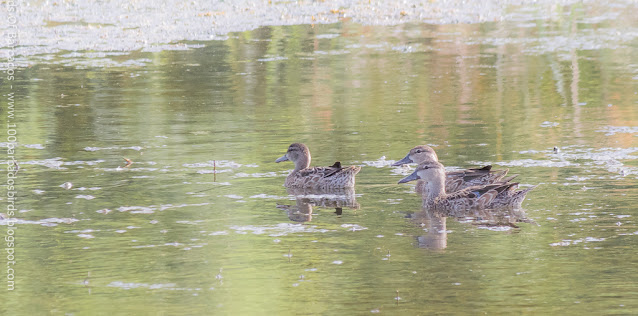
Blue-winged Teals (Spatula discors), our most numerous migratory duck.

  • Close to ten at three locations in St. Lucy;
  • 21 at Walkers and 3 at Greenland’s Irrigation Pond;
  • 7 at Redland, St. George were just a few of the sightings.  These numbers are expected to continue to increase into December.

We also saw small numbers of Lesser Scaups (Aythya affinis) and Ring-necked Ducks (Aythya collaris) at one of the local ponds but these numbers should also increase in the coming months.

November Rare Bird Sightings

As we enter the final month of the year, it is expected that ducks will continue to arrive.  Attention will also be focused on areas such as The Graeme Hall Swamp, Christ Church and the Turners Hall Woods St. Andrew, the last remaining original woodland on the island, for wintering song birds. Rare Bird Month 2021 is in the bag and yet another new species for the island, let's see if December will give us another one. 
Here are the rare birds seen during the month, highlighted below parish by parish. (* continuing Birds)

St. Lucy

Fulvous Whistling-Duck

  • Fulvous Whistling-Duck  (Dendrocygna bicolor)*  seen with a family of Black-bellied Whistling-Ducks (Dendrocygna autumnalis) at a private location;
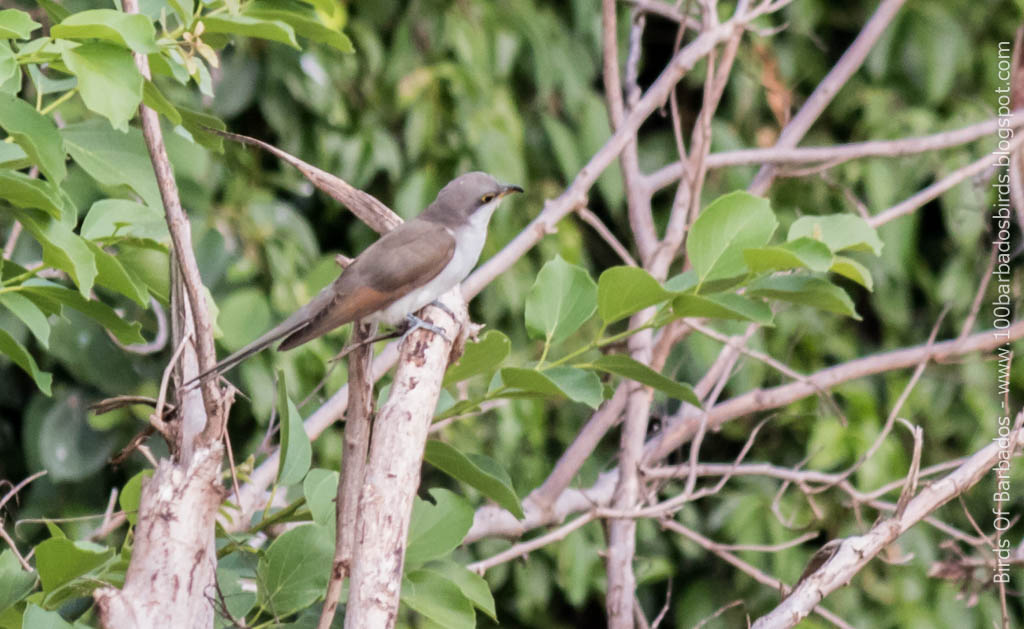
  • Yellow-billed Cuckoo (Coccyzus americanus)* (6) mostly seen feeding in a caterpillar infested field;
    Glossy Ibis
  • Glossy Ibis (Plegadis falcinellus)(2)* both Glossys were seen at the start of the month but only one was observed in the latter half.

St. Peter

Lesser Black-backed Gull
  • Lesser Black-backed Gull (Larus fuscus) one juvenile was seen at the fishing village at Six Men's Bay on the 14th.

St. Andrew

American Coot with chicks @ Greenland

  • American Coot white-shielded (Fulica Americana)* (13) 6 birds at Walkers Reserve,  7 at Greenland’s Irrigation Pond – one adult, half of a breeding pair whose partner is red-shielded, produced six chicks.
  • American Coot – red-shielded (Fulica Americana)* one of a breeding pair at Greenland.
  • Fulvous Whistling-Duck  (Dendrocygna bicolor) (2) birds seen at Walkers Reserve with Black-bellied Whistling-Ducks (Dendrocygna autumnalis) making a total of three birds on island during the month.

St. James

  • Least Tern (Sternula antillarum) seen by a visitor while catamaraning just off shore;
  • Common Tern (Sterna hirundo) seen by a visitor while vacationing at the beautiful Fairmont Royal Pavilion Resort.

ST. Philip

  • Pacific Golden-Plover (Pluvialis fulva)* this shorebird was last seen on November 13th
  • Least Tern (Sternula antillarum) another resort sighting by a visiting birder - This time the bird was seen at the luxury Crane Beach Resort.


Christ Church

  • Common Tern (Sterna hirundo) (6) on the ice pier at Oistins
  • Squacco Herons (Ardeola ralloides) a new species for the island, first seen at the Graeme Hall Swamp on the 26th and lastly on the 28th.


Feel free to contact me, Julian Moore @ 100birdsbarbados@gmail.com, John Webster @ barbadosbirds@gmail.com, or Ed Massiah @ ebmassiah@hotmail.com to report any rare bird sightings, or if you need assistance identifying a bird, we would be happy to assist.     


Saturday, 27 November 2021

Squacco Heron – A New Species for Barbados

Squacco Herons
It can easily be mistaken for the more common Cattle  Egret (Bubulcus ibis), in breeding plumage.  For It is about the same size, with white and brown plumage, but the similarities were no match for the keen eyes of two visiting birders, Glyn and Helen Foley, who saw and identified the newest addition to Barbados ever-growing avian checklist,  Squacco Heron (Ardeola ralloides).  The bird was seen at the Graeme Hall Mangrove Swamp, Christ Church on Friday, November 26, and then again on the following day,

Squacco Herons (Ardeola ralloides) are small, old-world herons about, 17.5 –1 8.5” (44–47 cm) long, and is common in South-West and Central Europe, East to Aral Sea region and South-east Iran. It is also present in Africa in the region of the Sahara, and in Madagascar' while breeding occurs in southern Europe and the Greater Middle East. This heron prefers freshwater habitats such as swamps and flooded areas, lakes, and ponds, where there is a dense cover of marshy vegetation, making Graeme Hall an ideal location.

A new species for the island is the perfect way to cap-off the Rare-bird Month. Let's hope it is not the last find for the year. Stay Safe and enjoy your birding. 

Tuesday, 16 November 2021

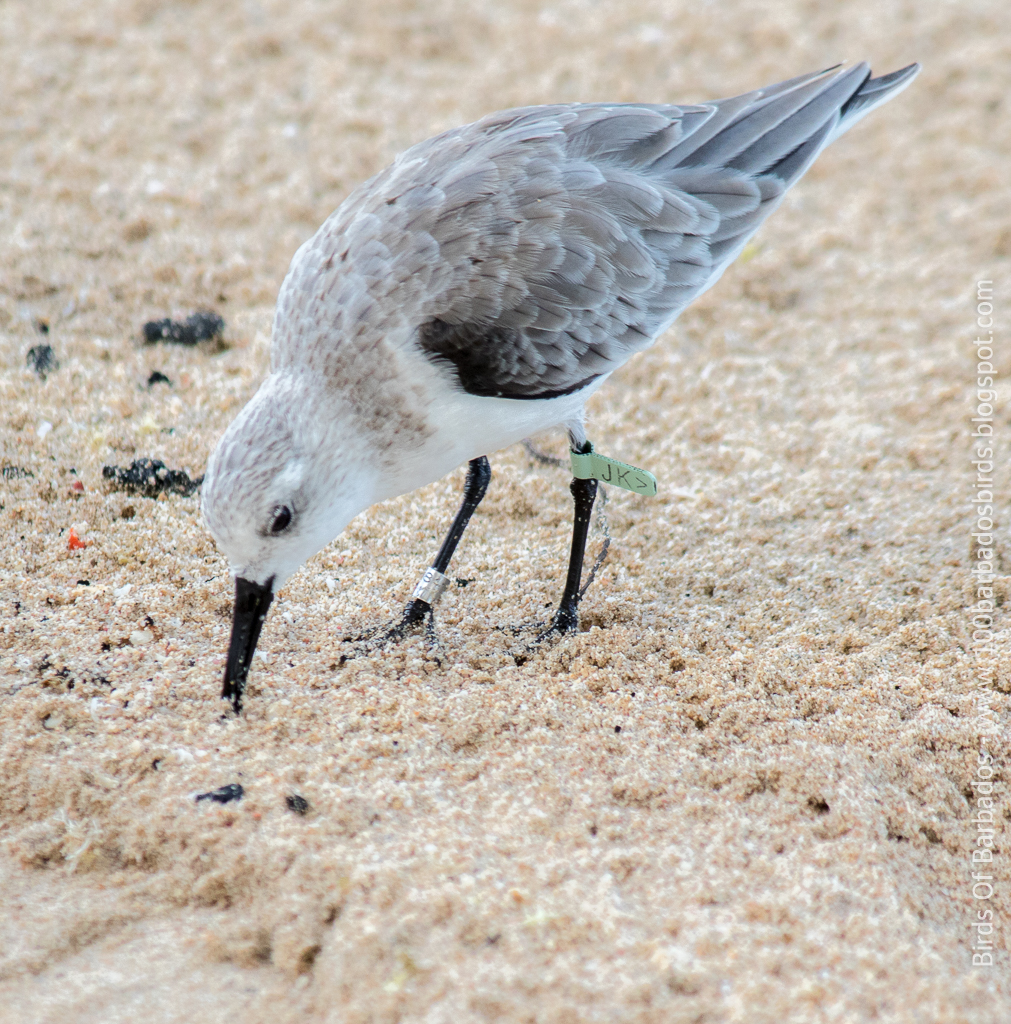
Banded Sanderling JK> At Six Men's Bay

Sanderling JK>
Look who is back at Six Men’s Bay – Sanderling JK>.   This bird was first seen and reported on by local photographer Himal Reece on January 3rd, this year before it migrated to North America (Read about it here).  Another sighting this year was made at Cooks Beach New Jersey, United States on May 6th.

Sanderling JK> was banded at Kimbles Beach, New Jersey, the United States on May 19th, 2019 and had a few sightings between then and now, of which you can see below:

  • 5/24/2019 - Reeds Beach - south, New Jersey, United States
  • 5/30/2019 - Kimbles Beach - north, New Jersey, United States 
  • 6/1/2019 - Villas Beaches, New Jersey, United States 
  • 7/29/2019 - Moores Beach - creek, New Jersey, United States
  • 1/3/2021 - Six Mens Bay, N/A, Barbados 
  • 5/6/2021 - Cooks Beach - north, New Jersey, United States 

This return to Six Men’s Bay by Sanderling JK> is a sign that it was finding pleasing conditions there.  I will be on the lookout to see if he will spend the winter with us like last year. I reported the resighting to www.bandedbirds.org. 

Have a great week and enjoy your birding.

Saturday, 13 November 2021

Two Mega Rare birds for Rare Bird Month

November rare birds month started slowly. This may not be because of a lack of birds but because of a lack of birders out there to find them.  Then last week two persons, one a visiting birder, reported seeing two megas. 

White-crowned Pigeon
The first one is a White-crowned Pigeon (Patagioenas leucocephala), a bird that resembles our Scaly-naped Pigeon (Patagioenas squamosa) aka Ramier in shape, size, and color, with the major difference being a prominent white-crowned or head.  This bird was seen at the rear entrance of the UWI, Cave Hill.  The first-ever record of this species on the island was on April 9th, 2014 at  Moncrieffe, St. John.
Reddish Egret  - internet image (CC)BY-SA 3.0 
.

The second bird, a Reddish Egret (Egretta rufescens), is even more rarer. If confirmed, this may be a first for the island.  The bird was seen once at Westmoreland, St. James by a visiting birder.  Sadly he was unable to get a photograph of the bird making the job of the regional reviewer much more difficult.  Our Little Blue Heron (Egretta caerulea) can be easily be mistaken for this species.  Both are about the same size and color, with the Egret being a bit larger, with a reddish-brown neck and a more shaggy appearance.  

The local birders will be on the lookout for these two species and encourage you to do the same. If you see a bird that is unfamiliar to you, take a photograph of it, doesn't have to be a perfect image, any image will do.  If the bird is calling or singing, record it on your cell phone. You can share it with us in three ways:

  1. You can use the comment section of this post.
  2. Share it in The Birds of Barbados Facebook group.
  3. or can also email us at one of these email addresses:

A slow start to November rare birds month but we have two mega-rare sightings to be excited about, and that is great,

Stay safe and enjoy your birding.


Sunday, 7 November 2021

The Barbados Birds and Birding Report – October

October may not be the best month of the year, but being so close to the best month, September, has its rewards.  The reward?  An almost equally remarkable month of birding and birds.  We saw seven new year species, which brought the island’s 2021 species tally to 108.  These species were:

  • Yellow-billed Cuckoo (Coccyzus americanus)
  • Lesser Black-backed Gull (Larus fuscus)
  • Northern Shoveler (Spatula clypeata)
  • Gull-billed Tern (Gelochelidon nilotica) 
  • Blackpoll Warbler (Setophaga striata)
  • Bobolink  (Dolichonyx oryzivorus)
  • Common Nighthawk (Chordeiles minor)

Two global birding events, during the month in celebration of World Migratory Bird Day, also added to this upbeat month of birds and birding.  These events took place between October 8th, to the 10th and saw a combined tally of 66 bird species, which included a few rare species.  These rare birds were:

  • Hudsonian Godwit (Limosa haemastica)
  • Least Tern (Sternula antillarum)
  • Snail Kite (Rostrhamus sociabilis)
  • Striated Heron (Butorides striata)
  • Tricolored Heron (Egretta tricolor) 
  • Glossy Ibis (Plegadis falcinellus)
  • Buff-breasted Sandpiper  (Calidris subruficollis)

October's Rare Bird Sightings

We saw a large increase in the number of rare bird sightings during October but our expectation for November is even higher.  A few years ago Ed Massiah coined the term for November, calling it Rare Bird Month.  This is because historically not just rare birds have turned up in this month, but mega-rare birds, birds you normally see once-in-a-life time in this region.  Here are a few examples of mega-rare birds seen during November:

  • Eurasian Marsh-Harrier (Circus aeruginosus)  - 5th November 2015
  • Franklin's Gull (Leucophaeus pipixcan) -  24 Nov 2015
  • Common Cuckoo (Cuculus canorus) - 19 Nov 2014
  • Blackburnian Warbler (Setophaga fusca) – 2nd November 2014,
  • Common Shelduck (Tadorna tadorna)  - 18 Nov 2013
  • Greater Ani (Crotophaga major) - 18 Nov 2012
  • Glaucous Gull (Larus hyperboreus) - 15 Nov 2009

So help us keep an eye out for our next mega-rare bird, but for now here is a list of the rare birds seen during the month of October, highlighted below parish by parish. (* continuing Birds)

St. Lucy

  • Upland Sandpiper (Bartramia longicauda) - seen on 23rd October flying over a private wet area, the numbers of this species seen this year were lower than normal.

    Blackpoll Warbler
  • Blackpoll Warbler (Setophaga striata) - I was fortunate to see this small warbler at Bright Hall, the only record for the year thus far.
  • Bobolink  (Dolichonyx oryzivorus) (5) - two at Archer's Bay and three at Bright Hall.
  • Gull-billed Tern (Gelochelidon nilotica) - one bird seen flying around a pond on the 17th
  • Hudsonian Godwit (Limosa haemastica) - one bird in a private location.
  • Least Tern (Sternula antillarum)* - we had multiple sightings of this small tern at North Point during the month. 

    Yellow-billed Cuckoo 
  • Yellow-billed Cuckoo (Coccyzus americanus)(3) - three sightings - first at Greenridges on the 2nd, then at Hannays Road on the 11th and finally at Mount Poyer on the 23rd.
  • Glossy Ibis (Plegadis falcinellus)*(2) two of the three birds first seen last month remain at the same location.
St. Andrew

  • American Coot - White shielded (Fulica Americana) (5)*  four birds at Walkers Reserve which has become one of the established breeding areas for this species on the island, with multiple successful nesting records over the last year, and one bird not too far away at Greenland's Irrigation Pond.
  • American Coot - Red-shielded (Fulica Americana) (2) the rarer of the two varieties found on the island - seen at Greenland's Irrigation Pond.

St. Joseph

  • Sandwich Tern (halasseus sandvicensis) - This tern was seen at Bathsheba. 

St. Thomas

Snail Kite

  • Snail Kite (Rostrhamus sociabilis) - this bird continue to expand its local range, mosts likely in search of food.
  • Striated Heron (Butorides striata) is becoming a staple at the SBRC pond
St. Philip

  • Pacific Golden-Plover (Pluvialis fulva) - seen on the 23rd, the second for the year.

    Gull-billed Tern
  • Gull-billed Tern (Gelochelidon nilotica) - normally a yearly visitor, first seen on 23rd, could be the same bird seen in St. Lucy  relocating to the east
  • Buff-breasted Sandpiper (Calidris subruficollis)*(2) - maybe two of the three birds seen last month.
  • Red Knot (Calidris canutus) - one seen on 23rd


Christ Church

Ruff @ WSR

  • Ruff (Calidris pugnax) - seen at Woodbourne Shorebird Refuge, the 3rd bird for the year, the second at WSR.

    Tricolored Heron
  • Tricolored Heron (Egretta tricolor)* - seen at Woodbourne Shorebird Refuge.
    Male Northern Shoveler
  • Northern Shoveler (Spatula clypeata) (3) - seen at WSR 
  • Yellow-billed Cuckoo (Coccyzus americanus)(2) - a mystery in the making as two dead birds were found on the Boardwalk at Hastings, under a tree frequented by a Peregrine Falcon (Falco peregrinus), probably not that much of a mystery after all.

    Hudsonian Godwits
  • Hudsonian Godwit (Limosa haemastica)(3) - at WSR, one remained into November.
  • Least Tern (Sternula antillarum)(2) - two seen between Chancery Lane and Long Beach.
  • Bank Swallow (Riparia riparia) - seen on the 18th at Oyster Crescent
  • Snail Kite (Rostrhamus sociabilis) - this bird continue to expand its local range, most likely in search of food.  It was seen by John Webster on the 24th at WSR.
  • Common Nighthawk (Chordeiles minor) - seen at Lowthers.  The viewer described the bird as having pointy wings, broad white wing bars clearly seen when bird banked. He also heard the bird calling on the following day at the same location.  Separation from Antillean nighthawk (Chordeiles gundlachii) by time of the year it was seen.
  • Glossy Ibis (Plegadis falcinellus) (1) seen at WSR.  It was most likely one of the three birds first reported on in St. Lucy which has now relocated to Christ Church.

St. Michael

  • Snail Kite (Rostrhamus sociabilis) - even though this bird is expanding its local range it always returns to its Bay Street roost.

    Juvenile Lesser Black-backed Gull
  • Lesser Black-backed Gull (Larus fuscus) a juvenile gull was seen at Pile Bay on the 6th.

Feel free to contact me, Julian Moore @ 100birdsbarbados@gmail.com, John Webster @ barbadosbirds@gmail.com, or Ed Massiah @ ebmassiah@hotmail.com to report any rare bird sightings, or if you need assistance identifying a bird, we would be happy to assist.