 |
| Two male Blue-winged Teals in breeding plumage |
 |
| Ruddy Turnstones and Sanderlings @ Inch Marlow |
 |
| Ruddy Turnstones in various stages of molting, Sanderlings, Least Sandpipers, and Semipalmated Sandpiper |
Stay Safe and enjoy your birding.
|
| Two male Blue-winged Teals in breeding plumage |
|
| Ruddy Turnstones and Sanderlings @ Inch Marlow |
|
| Ruddy Turnstones in various stages of molting, Sanderlings, Least Sandpipers, and Semipalmated Sandpiper |
Stay Safe and enjoy your birding.
Visiting birders dominated during the month of March. Over twenty of them submitted over 120
of the 188 checklists that were submitted to ebird.org during the month. I do hope the Ministry of Tourism is taking
note. Together with our local birders added three
new birds, Laughing Gull (Leucophaeus atricilla) Leach's Storm-Petrel
(Hydrobates leucorhous), and Western
Sandpiper (Calidris mauri), to
the island’s year checklist, ending the month with 81 species.
The sighting of the Leach's Storm-Petrel highlighted an
area of the local avian fauna that is least explored, that of the birds that inhabit
the seas around our island, pelagic birds. These are birds that spend most of their life
at sea only returning to, or close to land for nesting or during bad weather. Storm-Petrels are some of the smallest birds
in that group. For example, Leach's
Storm-Petrels are between 5 – 7” in length (12-17cm), which is about the
size of a Common Ground-Dove (Columbina passerina). So if any of you readers have a boat, we would
not mind tagging along with you every now and then, all in the name of science.
March Rare Bird Sightings
Very few new rare birds entered the list during March., and after this would be the last time the American Coot white-shielded (Fulica Americana) will be listed as a rare
bird, as was done by ebird. This bird continues to nest successfully at a few locations across the island. The red
shielded variety, which is the rarer of the two will continue to
be listed.
St. Lucy
Glossy Ibis
St. Andrew
St. Thomas
St. John
Grey Heron
ST. Philip
 |
| Black-headed Gull |
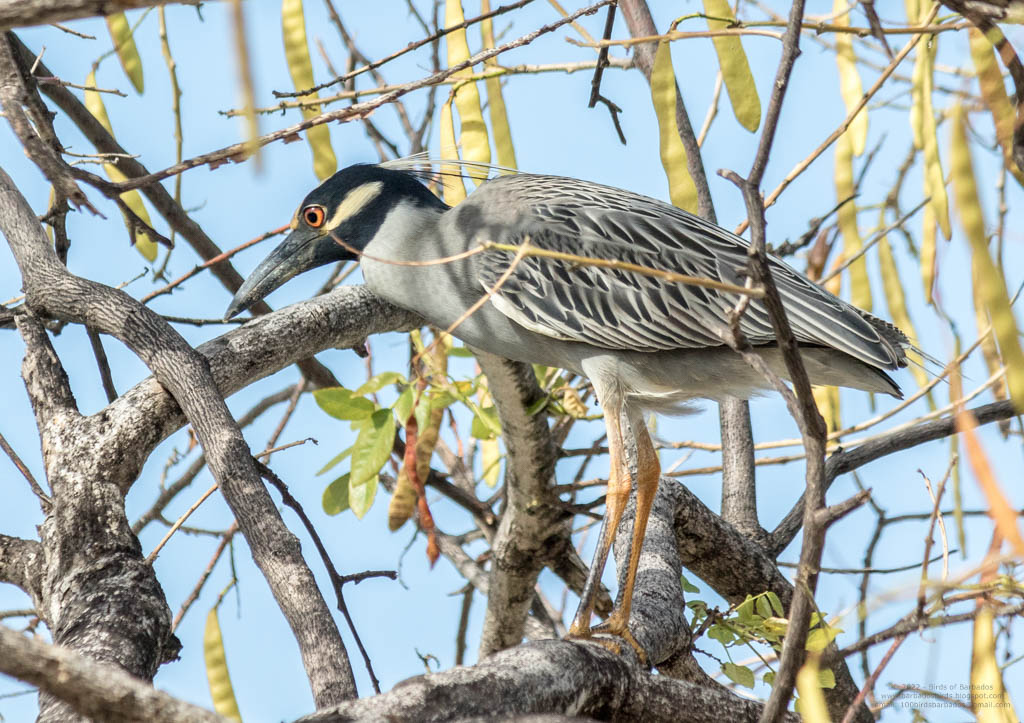 |
| Yellow-crowned Night-Heron |
Feel free to contact
me, Julian Moore @ 100birdsbarbados@gmail.com, John Webster @
barbadosbirds@gmail.com, or Ed Massiah @ ebmassiah@hotmail.com to report any
rare bird sightings, or if you need assistance identifying a bird, we would be
happy to help.
 |
| Yellow-crowned Night-Heron |


After a dream start to 2022, birding-wise, February brought things back down to earth. We only add two species to the year’s tally, Caribbean Martin (Progne dominicensis) and a Pacific Golden-Plover (Pluvialis fulva) closing the month with 79 species.
February Rare Bird Sightings
Here are the rare
birds seen during the month, highlighted below parish by parish. (* continuing
Birds)
St. Lucy
 |
| The long-stay Glossy Ibis remains steady in the north |
St. Andrew
 |
| The American Coot population continues to increase |
 |
| Magnolia Warbler continues at THWs |
St. George
ST. Philip
Christ Church
 |
| Two sightings of a Black-headed Gull at Oistins |
Feel free to contact
me, Julian Moore @ 100birdsbarbados@gmail.com, John Webster @
barbadosbirds@gmail.com, or Ed Massiah @ ebmassiah@hotmail.com to report any
rare bird sightings, or if you need assistance identifying a bird, we would be
happy to help.

Participating is easy, fun to do alone or with others, and can be done anywhere you find birds.
What a busy start to the new year we had, seventy-six species of birds reported, with an increase in rare birds sightings. This surge could be the result of the colder than normal conditions we had throughout the month, or it could just be that the main birders were all out in earnest. All three, Ed Massiah, John Webster and myself recorded at least one local lifers during the month. One of us is doing a big year for sure, while another may be secretly doing or considering doing one, but the fact is, when these three are birding with a purpose, we tend to see more bird species being reported. A lot of help was provided by the over ten other birders, local and visitors, who submitted over 70 checklist to ebird. Let's hope this drive continues into February and for the remainder of the year.
January Rare Bird Sightings
Here are the rare
birds seen during the month, highlighted below parish by parish. (* continuing
Birds)
St. LucyGlossy Ibis
St. AndrewAmerican Coot (white-shielded)
 |
| American Coot (red-shielded) |
 |
| Magnolia Warbler |
St. JosephBaltimore Oriole
St. ThomasSnail Kite
St. George
ST. PhilipPurple Gallinule
Christ Church
 |
| Northern Shoveler |
 |
| Black-headed Gull |
 |
| Cape May Warbler |
 |
| Northern Parula |
St. MichaelLesser Black-backed Gull
Feel free to contact
me, Julian Moore @ 100birdsbarbados@gmail.com, John Webster @
barbadosbirds@gmail.com, or Ed Massiah @ ebmassiah@hotmail.com to report any
rare bird sightings, or if you need assistance identifying a bird, we would be
happy to help.
Birding for wood-warblers is a tedious
task. There are small birds, between 4
-6” in length, very active, and tend to forage high up in trees. The constant
looking up normally leaves you with neck pains, a condition known in birding
circles as Warbler
Neck. To add to the pain(😂), for an island like Barbados, which
is not in the range of many of these families of birds, the rewards, in terms of
numbers seen, are not too high. In January
2022 though we saw species of warblers we don’t commonly see on the island. I am not sure if this was caused by some atmospheric
anomaly, or because we, the birders, just spent more time looking for these birds, in habitats
where there are known to frequent, like Turners Hall Woods, Graeme Hall Swamps,
etc of both. Whatever the reason, it was
exciting to see these rare warblers. Here are the warblers recorded from our native species to the much rarer ones.
Golden Warbler, the local subspecies of the Yellow warbler

 |

 |


 |
 |
 |


 |

 |


