Showing posts with label birds. Show all posts

Monday, 13 January 2025

The Barbados Birds and Birding Report - November, December

Glossy Ibis no longer consider a rare species
After a bustling October, November and December brought a sense of normalcy with three new yearbirds in November and one in December, wrapping up 2024 with a total of 122 species recorded in Barbados. The three November birds, all mega-rarities, included a Gadwall (Mareca strepera) spotted in St. Lucy, an Eastern Wood-Pewee (Contopus virens), and a Nashville Warbler (Leiothlypis ruficapilla), the latter being a first for the island. December's sole yearbird was a Black-headed Gull (Chroicocephalus ridibundus).  The Glossy Ibis ( Plegadis falcinellus) has been a regular feature in this report for several months. Consequently, its status on the island has been upgraded from rare to locally common. Therefore, it will no longer be individually highlighted in this report.

Looking Ahead to January
January is usually very quiet in terms of rare bird arrivals, so don't expect much. However, we have a few birders doing a big year, along with the additional eyes from our new local birders, who completed the tour guide training, plus the start of the tourist season and we are seeing more visitor birding. If there's something to be seen, we will see it. Here is a recap of those rare bird sightings from the previous months, organized parish by parish.
(* denotes birds that remained from previous months)

St. Lucy

  • Red Knot (Calidris canutus)(1) a bird seen and photographed by Michael St. John on November 11 and 19th;
    Hudsonian Godwit
  • Hudsonian Godwit (Limosa haemastica) - one bird at North Point on November 14th, last seen on 16th;
    Gadwall 
  • Gadwall (Mareca strepera) - the duck was seen first seen by Mike St. John on 15th, it relocated to another location in the parish and remain into the new year;
  • Fulvous Whistling-Duck (Dendrocygna bicolor) - long stay bird
  • Common Swift (Apus apus) - discovered by Niels Larsen at Harrison's Point on the 26th. Identity confirmed by Ed Massiah;
Western House Martin
  • Western House Martin (Delichon urbicum) (8) was first seen in a mixed flock of swallows on the 23rd at Harrison's Point. (see)
Lesser Black-backed Gull
  • Lesser Black-backed Gull (Larus fuscus)—This bird was seen and photographed at North Point during the October Big Day, but the juvenile bird was spotted at multiple locations around the island thought November and into December, being last seen on December 6th in St. Philip. 
  • Tricolored Heron (Egretta tricolor) (2) - two birds seen at North Point on the 5th.  

St. Andrew
Prothonotary Warbler

  • Prothonotary Warbler (Protonotaria citrea) this warbler was recorded at Turners Hall Woods by Julian and Jason Moore on December 14th;

St. Philip

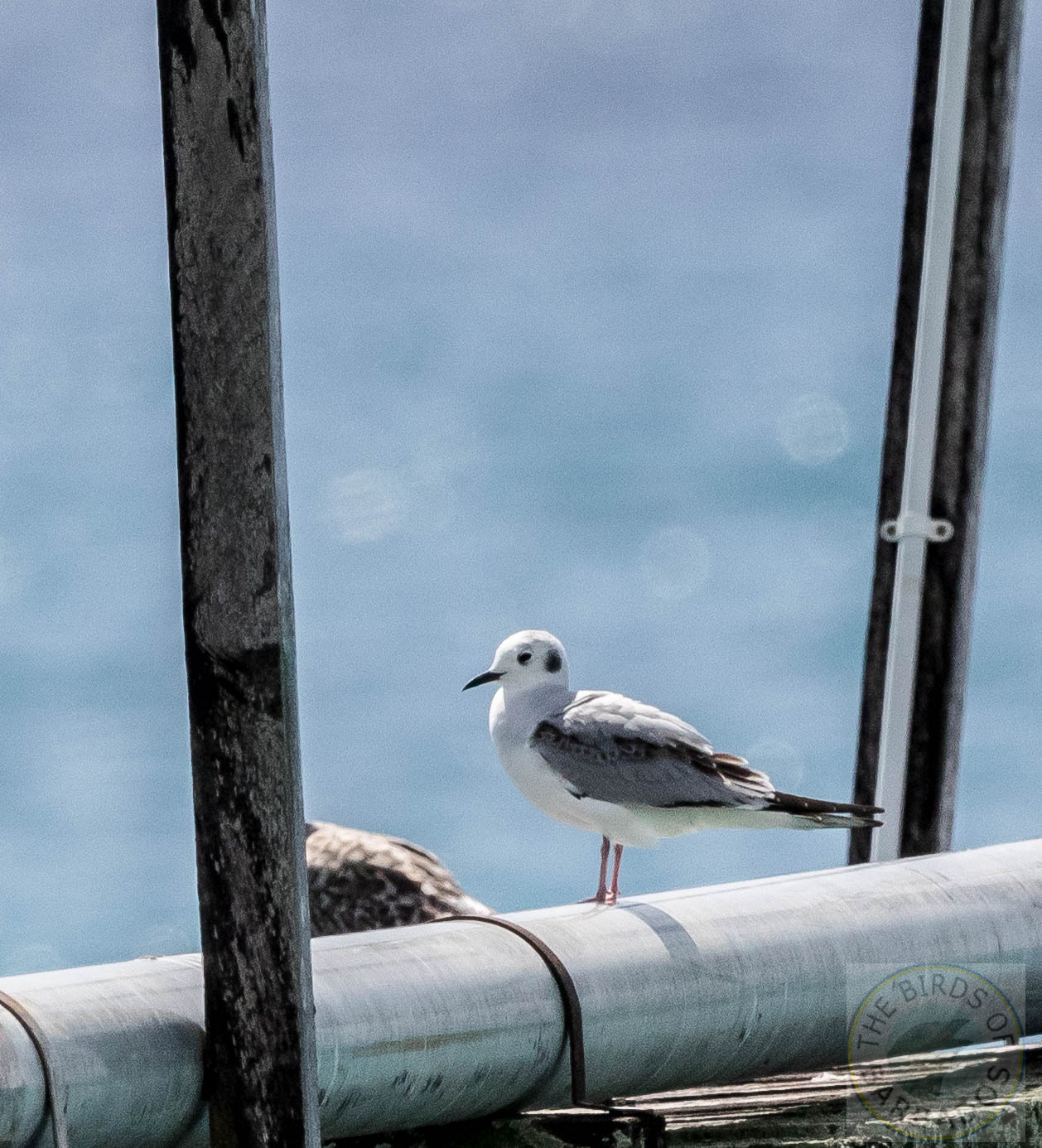
  • Black-headed Gull (Chroicocephalus ridibundus) first seen by John Webster on December 28th. This bird moves between this location and Oistins, in Christ Church;
  • Lesser Black-backed Gull (Larus fuscus) this bird was first seen in October but was last seen in this parish on December 6th;

Christ Church

  • Fulvous Whistling-Duck (Dendrocygna bicolor) - seen at Woodbourne Shorebird Refuge during the October Big Day Islandwide birding event;
    Gull-billed Tern
  • Gull-billed Tern (Gelochelidon nilotica) suddenly appeared at WSR on November 16th
  • Eastern Wood-Pewee (Contopus virens) - heard by Ed Massiah at Graeme Hall Swamp;
  • Nashville Warbler (Leiothlypis ruficapilla) - A new species for the island, first seen on November 14th and last seen on December 7th;
  • Tricolored Heron (Egretta tricolor) seen at Woodboure Shorebird Refuge throughout November and December and into the new year .
  • Bridled Tern (Onychoprion anaethetus) (5) - seen by Quncy Clarke at Oistins on November 17th;
    Lesser Black-backed Gull
  • Lesser Black-backed Gull (Larus fuscus) this bird made it round at different location around the island and was seen at the Oistins ice pier on the 16th of November;
  • Black-headed Gull (Chroicocephalus ridibundus) first recorded in St. Philip but was frequently seen on the ice pier at Oistins;
    Northern Parula
  • Northern Parula (Setophaga americana) this wood warbler was a surprised find at the Graeme Hall Swamp by Julian Moore and Ocean Campbell.
St. Michael
  • Masked Booby (Sula dactylatra) (4) seen offshore by a visitor cruising into the island.
Feel free to contact me, Julian Moore @ 100birdsbarbados@gmail.com, John Webster @ barbadosbirds@gmail.com, or Ed Massiah @ ebmassiah@hotmail.com to report any rare bird sightings, or if you need assistance identifying a bird, we would be happy to help.  A new tool to help with your local bird identification is our Facebook Group, The Birds of Barbados. Click here to join   

Thursday, 22 February 2024

Wader Frenzy At WSR

A collection of waders, mostly heron and egrets, feeding at WSR
The dry season brings many ponds and wetlands that depend on rainwater to the brink of drying up. The water retreats and leaves behind the numerous creatures, fish, tadpoles and insects that dwell there, exposed. They are easy targets for the wading birds, such as herons and egrets, who swarm in masses to dine on them. This yearly phenomenon, if witnessed, can be a marvelous experience for nature lovers. I got the opportunity to see it this year at the Woodbourne Shorebird Refuge (WSR) and it highlighted why Barbados, though not the most birdy places on earth, is one of the most unique birding locations in the Americas. How so? Because it is one of the few places where you can commonly observe new world and old-world versions of some bird species.

Snowy Egret (Foreground) and Little Egret (Background)

Among the many white egrets busy feeding, a discerning eye could distinguish the Snowy Egret (Egretta thula) and its old-world counterpart, the Little Egret (Egretta garzetta), in the mix. To spot the Snowy Egret, an indigenous bird of the Americas, one only has to look for the bright yellow skin that separates the eyes and the bill, the lores, and its shaggy head crest. Its cousin from across the ponds, the Little Egret, which arrived on this island in the mid 50s, has much paler lores and a more neat and uniform double or single plume coming from the back of the head.

Grey Heron (Left) and Great Blue Heron (Right)
Another such and even rarer example of new and old-world versions of a species living side by side naturally was that of the Great Blue Heron (Ardea herodias) and its old-world cousin the Grey Heron (Ardea cinerea). These two are even more challenging to tell apart, and I must admit I am still learning the differences between these two species. One field marking that I do look for is the color of the thighs. The Great Blue Heron’s thighs are brownish while the Grey’s ones are always pale.

Little Blue Heron
While these were some of the more interesting species in the frenzy, they were not the only ones. Continuing in the heron family, there were a few Green Herons (Butorides virescens), Little Blue Herons (Egretta caerulea) and also, as it got later in the evening, two Black-crowned Nightherons (Nycticorax nycticorax) joined the mix. From the egret side of things, there was the ubiquitous Western Cattle Egret (Bubulcus ibis) and Great Egret (Ardea alba), a bird which is common on both sides of the great pond. In total, eight species of egrets and herons were on display at the WSR, feasting on the critters trapped by the receding water level.
It was a sight to behold and one I am glad to share. Stay safe and enjoy your birding.


Saturday, 13 January 2024

2023, An Epic Year of Birds and Birding


Shorebirds in the sunset of 2023
Barbados had a remarkable year of birding in 2023. More than 100 birders, mostly tourists, sent over 1400 checklists to ebird.org, documenting a stunning 126 bird species, the highest tally in over a decade. The year unveiled a treasure trove of rarities, with three, possibly four, species gracing the island for the first time ever: 
They were:
  • House Swift(Apus nipalensis) or Little Swift (Apus affinis), either one would be a first for the island 
  • Mississippi Kite (Ictinia mississippiensis) was seen in July, and
  • Blue-winged Warbler (Vermivora cyanoptera)  
  • Grey-breasted Martin (Progne chalybea) or Brown-chested Martin (Progne tapera) - Another bird that is still with the experts.  This bird was seen and photographed by Quncy Clarck at Harrison's Point, St. Lucy.  If ratified as either one of the two this would be the 127 species for the year.
Some of them had not been seen on the island for over 10 years. These included: 
  • Garganey (Spatula querquedula) which was last seen in 2000 before last year's sighting.

  • Curlew Sandpiper (Calidris ferruginea) seen in 2001 before 2023
  • Bonaparte's Gull (Chroicocephalus Philadelphia), the last addition for 2023 was last recorded on the island in 1981 at Chancery Lane, that is 42 years ago! (The Birds of Barbados, by Buckley, Massiah et al.)
  • Manx Shearwater (Puffinus puffinus) - the wounded bird found on Morgan Lewis beach, St. Andrew was the second verified record for the island and the first since 2005.
  • Northern Wheatear (Oenanthe oenanthe) was last spotted in 1994 before 2023. Last year's record is the third sighting of this species on the island.
 There were a few other amazing records in 2023. Some of the standout records were: 
  • The incredible voyage of Osprey (Pandion haliaetus) KW0. This bird was tagged as a fledgling in Scotland on June 23rd, 2022, and spotted by local birdwatcher Michael St. John on March 9th, 2023. It is hard to fathom how such a young bird traveled so far.
  • The astounding number of Bobolinks (Dolichonyx oryzivorus) at Harrison’s Point in October. On several occasions, they counted more than 200 birds at a time. They were so abundant that they outnumbered Shiny Cowbirds (Molothrus bonariensis) as the most numerous species in the area, which is no easy feat.
  • The impressive abundance of some shorebird species, especially during the peak migration months. For instance, from September 16th to 19th, more than 300 American Golden Plovers (Pluvialis dominica) were recorded at Chancery Lane, Christ Church, and then more than 600 birds on the island from September 22nd to 26th. These were only the highest peaks of this species’ movement, as a consistent and large migration was observed throughout September.
    Whimbrel
  • Some other bird species that had a higher-than-usual individual count in 2023 were Whimbrels (Numenius phaeopus), Stilt Sandpipers (Calidris himantopus), Red Knots (Calidris canutus), Hudsonian Godwits (Limosa haemastica) Greater Yellowlegs (Tringa melanoleuca), Common Terns (Sterna hirundo) and Glossy Ibis (Plegadis falcinellus).
The remarkable records set by birds in 2023 showed how vital Barbados is as a key destination for winged travelers on their worldwide journeys. From the solo voyage of a brave osprey to the combined force of visiting songbirds and the stunning numbers of migrating ducks and shorebirds, 2023 showcased the diversity and beauty of birds and birding in Barbados. These records were only a sample of what we witnessed in 2023, and we are excited to see what wonders lie ahead in the future. We will keep you updated as always.

I hope you had a wonderful birding 2023 and I do wish you a better 2024, birding-wise and otherwise, and as always - Enjoy your birding. 

Thursday, 4 January 2024

The Barbados Birds and Birding Report - December

December wasn't a month for major avian discoveries in Barbados, but two new feathered friends were still added to the 2023 checklist:

Bonaparte's Gull

  • Bonaparte's Gull (Chroicocephalus philadelphia): This charming gull in non-breeding plumage was seen at Oistins, Christ Church for a few days before disappearing.
    A male Northern Pintail at WSR

  • Northern Pintails (Anas acuta): These elegant ducks with long, slender necks were spotted at two separate locations on the island.

These additions brought the year-end tally of birds seen on Barbados in 2023 to an impressive 126 species, a testament to the island's rich and diverse birdlife. Stay tuned for a more comprehensive review of 2023's birding highlights coming soon!

December's Rare Bird Sightings

Here is a review of the rare bird sighting for December. (*birds that stayed from previous months)

St. Lucy

one of the six long-stay Glossy Ibis

  • Glossy Ibis (Plegadis falcinellus)(6)*- This flock has been loyal to this location since joining a single bird there in October 2022. Seeing one of them with what appears to be nesting material earlier in the year, has sparked hope for Barbados' first ibis chick.
  • Fulvous Whistling-Duck (Dendrocygna bicolor)*(2) –  Long say birds, maybe a pair, often seen with Black-bellied Whistling Ducks (Dendrocygna autumnalis)
    Grey Heron

  • Grey Heron* (Ardea cinerea) - one of the island's annual Eurasian visitor 
St. Thomas
  • Striated Heron (Butorides striata)* - Made a brief appearance at its usual stomping ground at the SBRC pond. 
Christ Church
Bonaparte's Gull
  • Bonaparte's Gull (Chroicocephalus philadelphia) - First seen at the Oistins is pier on the 26th, last seen on the beach at the same location.
    One of the two juvenile Lesser Black-backed Gull at Oistins
  • Lesser Black-backed Gull (Larus fuscus) (2)* - most likely the same juvenile birds seen at Pile Bay, St. Michael in November.
Feel free to contact me, Julian Moore @ 100birdsbarbados@gmail.com, John Webster @ barbadosbirds@gmail.com, or Ed Massiah @ ebmassiah@hotmail.com to report any rare bird sightings, or if you need assistance identifying a bird, we would be happy to help.  A new tool to help with your local bird identification is our Facebook Group, The Birds of Barbados. Click here to join   

Tuesday, 17 October 2023

October Birding at HP

Northern Wheatear, one of my two Harrison's Point Lifers for 2023
Harrison’s Point (HP), St. Lucy, is my favorite birding spot in October. This place is known for attracting migratory sound birds every year. This month has been halfway through, and I have already seen some regular visitors and some unexpected ones.

A Blackpoll Warbler at HP last year
Some of the birds that I usually see at HP around this time are Blackpoll Warblers (Setophaga striata), Yellow-billed Cuckoos (Coccyzus americanus), and Bobolinks (Dolichonyx oryzivorus). They have all shown up this year as well. Sometimes, HP also surprises me with some rare birds, like the Black and White Warbler (Mniotilta varia) and Summer Tanager (Piranga rubra) that I saw last year, or the Black-throated Green Warbler (Dendroica virens) and Blackburnian Warbler (Setophaga fusca) that was spotted in 2014.

Prothonotary Warbler, my first record of this warbler at HP
This year, I have seen four special birds so far, two of which were lifers for me - the elusive Upland Sandpiper (Bartramia longicauda), the stunning Prothonotary Warbler (Protonotaria citrea), and then two lifers: a Northern Wheatear (Oenanthe oenanthe), which is extremely rare in this region and only the third record for the island, and the Rose-breasted Grosbeak (Pheucticus ludovicianus), which is probably the second record for the island. With just two more weeks to go in October, I will be looking forward to seeing more birds at Harrison’s Point.  


Saturday, 22 July 2023

Another New Bird Species for Barbados


This year has been full of amazing bird sightings on the island, with a new record of House Swift (Apus nipalensis) and some other rare species, like Garganey (Spatula querquedula) and Curlew Sandpiper (Calidris ferruginea), and we are only halfway through the year, with the fall migration just beginning. The surprises continued yesterday, July 20th, when a new birder made a remarkable discovery. Michael St. John was exploring a private marsh in the north of St. Lucy parish when he spotted and photographed a strange raptor that turned out to be a young Mississippi Kite (Ictinia mississippiensis). He said the bird stayed in the area for hours, diving and catching prey.


Mississippi Kites are small birds of prey, measuring 12 to 15 inches (30–37 cm) and having a wingspan of about 3 feet (91 cm). Young ones have brownish feathers with a striped tail. They nest mostly in the central and southern U.S., especially along the Mississippi River and the Great Plains, but they travel in large groups to South America during the fall.


We don’t know how this bird got here, but we do hope it sticks around for a while.


Saturday, 5 February 2022

The Barbados Birds and Birding Report – January

What a busy start to the new year we had, seventy-six species of birds reported,  with an increase in rare birds sightings. This surge could be the result of the colder than normal conditions we had throughout the month, or it could just be that the main birders were all out in earnest.  All three, Ed Massiah, John Webster and myself recorded at least one local lifers during the month.  One of us is doing a big year for sure, while another may be secretly doing or considering doing one, but the fact is, when these three are birding with a purpose, we tend to see more bird species being reported.  A lot of help was provided by the over ten other birders, local and visitors, who submitted over 70 checklist to ebird.  Let's hope this drive continues into February and for the remainder of the year.

January Rare Bird Sightings

Here are the rare birds seen during the month, highlighted below parish by parish. (* continuing Birds)

St. Lucy

Glossy Ibis

  • Glossy Ibis (Plegadis falcinellus)(1)*- the only one of the original three birds remaining at this location;

St. Andrew

American Coot (white-shielded)

  • American Coot white-shielded (Fulica Americana) (15)*- 12 adults and 3 juveniles at Walkers Reserve, which continues to be the hub for this species return to the island;
    American Coot (red-shielded)
  • American Coot red-shielded (Fulica Americana)(2) – at Walkers Reserve;
  • American Wigeon (Mareca Americana) (2) – two of these migratory ducks were reported on the 16th but were not seen on the 21st;
  • American Redstart (Setophaga ruticilla) – a yearly wintering warbler at Turners Hall Woods;
    Magnolia Warbler
  • Magnolia Warbler (Setophaga magnolia) – First seen on the 15th but identification was conformed by Ed Massiah on the 21st. The bird was last seen on the 29th, the last visit by a birder to Turners Hall Woods;
  • Pearly-eyed Thrasher (Margarops fuscatus) – another one of this year’s gems from the Turners Hall Woods.  Ed Massiah heard the repeated call of this Caribbean visitor on his visit to the woods on the 23rd.

St. Joseph

Baltimore Oriole

  • Baltimore Oriole (Icterus galbula) - a beautiful male seen at Chimborazo on the 26th.

St. Thomas

Snail Kite

  • Snail Kite (Rostrhamus sociabilis) – after not being seen for close to three months, the Snail Kite turned up in Farmers, St. Thomas on the 17th.   Sightings were also reported on the 20th and 21st.

St. George

  • American Coot white-shielded (Fulica Americana)* seen at Redland.

ST. Philip

Purple Gallinule

  • Purple Gallinule (Porphyrio martinica)*- sub-adult at the Bayfield’s Pond, first reported by a  visitor to the island but as subsequently molted, or in the process of molting,  into its beautiful adult plumage.
  • Tricolored Heron (Egretta tricolor) – this bird was seen feeding among white egrets and herons. Maybe the same bird from last year.

Christ Church

Northern Shoveler

  • Northern Shoveler (Spatula clypeata) - one duck was seen at Woodbourne Shorebird Refuge on the 23rd;
  • American Coot (Fulica Americana) – two juveniles  at a private location;
    Black-headed Gull
  • Black-headed Gull (Chroicocephalus ridibundus)* – the bird was seen on the ice pier at Oistins, along with a few terns on the 19th.  It was not seen since then;
  • Common Tern (Sterna hirundo) – first seen on the ice pier at Oistins on 19th last seen on the 21st ;
    Cape May Warbler
  • Cape May Warbler (Setophaga tigrina) – one of the two rare warbler species seen at the Graeme Hall Swamp during the month.  This bird was first seen by John Webster on the 23rd;
    Northern Parula
  • Northern Parula (Setophaga Americana) – this warbler was first seen on the 3rd then on 19th and  22nd ;

St. Michael

Lesser Black-backed Gull

  • Lesser Black-backed Gull (Larus fuscus) – this large immature gull was seen at the Bridgetown Fishing Complex on the 5th. It was most likely the same bird that was seen late last year at Pile Bay.

Feel free to contact me, Julian Moore @ 100birdsbarbados@gmail.com, John Webster @ barbadosbirds@gmail.com, or Ed Massiah @ ebmassiah@hotmail.com to report any rare bird sightings, or if you need assistance identifying a bird, we would be happy to help.  

Monday, 15 June 2020

Eared Dove (Zenaida auriculata)

Length: 9.4"(24 cm), intermittent size between Common Ground Dove at the smaller end, and Zenaida Dove ; Habitat: agrcultrual areas,  arid to semi-arid scrublandarid; Statue: local and expanding range, seen mostly in the dryer eastern parishes - St. Philip and St. John, expanding range to St. Lucy. Comment: A resent natural coloniser from South America first seen in the 1950s. 

Adult: head has a grey crown, black line behind the eye,bronzish  iridescence patch on neck

Upperparts olive- brown, black bill with black spots on 

underparts brownish red,  reddish-pink legs

female is duller than the male

Immature birds are greyish-brown, very dull, streaks on the breasts and sides of the neck