Monday, 8 March 2021

Birding after the Pause

Adapted from the blog The Enthusiastic Birder

The first week back to work after the “pause” was surprisingly busy.  It was good to be out of the house after weeks of confinement but I was a little nervous, even a little afraid because of the pervasiveness of COVID in society.  The routine of mask and face shield has become the norm for me, and disposable gloves are added to the mix depending on where I am going. It was refreshing being outdoors, seeing the different birds as I moved around the island. After work, on most of the days, I visited a few of the birding hotspots, utilizing that activity for exercise as afforded by the government's COVID-19 protocols.  During that week I tallied 32 bird species from 8 checklists, also adding 2 yearbirds namely Caribbean Martin (Progne dominicensis), which I saw in Bridgetown and Laughing Gulls (Leucophaeus atricilla) at Pile Bay.  You can see the full list of the birds I saw below.

I continue to be impressed with the Canon 7D Mark II, even as it is paired with the underwhelming (because of reach) Canon EF-s  55-250mm f/4 – 5.6 IS II, which effectively becomes 89.1 - 405mm (x1.62 crop sensor of the Canon 7D II).  Here are a few highlight images for that week. All images were lightly edited using Adobe Lightroom CS2.

On March 1st I had my best look at a Merlin (Falco columbarius) for the year. It was going after Eurasian Collared-Doves (Streptopelia decaocto) for dinner, and while the shots I got were not ones I would normally highlight, I love this one that shows the beautiful barring pattern in this raptor's tail. 

© Julian Moore  - birdingbarbados@gmail.com
Merlin showing its tail feathers  (1/4000 @ f8 ISO 1000 – 250mm)

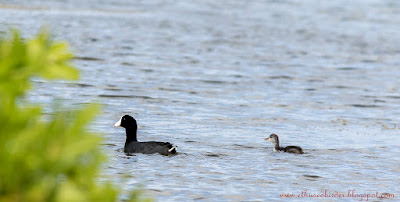
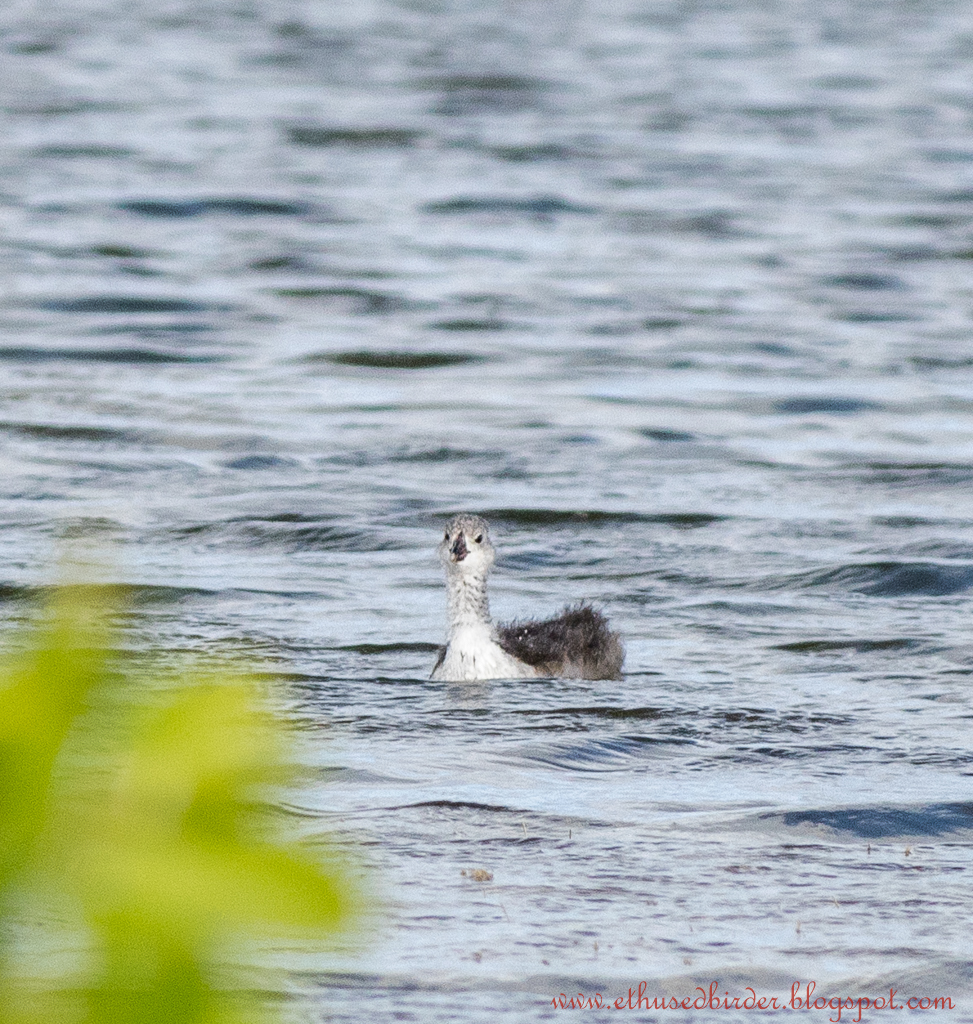
On the 3rd, my after work exercising took me to Chancery Lane Swamp, Christ Church. While there, I tried to photograph an American Coot (Fulica Americana) with her chicks.  This was not an easy task as both mum and chicks played peek-a-boo with me, using the mangroves for cover.  While I easily got images of both of them alone, the image below was the only opportunity I had of them together.

© Julian Moore  - birdingbarbados@gmail.com
Adult (1/1000 @ F/8 ISO 640 250mm)
 
© Julian Moore  - birdingbarbados@gmail.com
Juvenile  (1/1000 @ F/8 ISO 640 250mm)


© Julian Moore  - birdingbarbados@gmail.com
Mother & Chick ((1/1250 @ F/8 ISO 640 250mm)

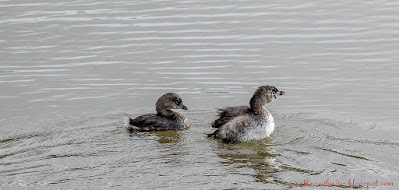
The following day, the 4th, I ended work in the north so I visited the irrigation ponds at Bawdens, St. Andrew, and had a short photo session with a pair of Pied-billed Grebes (Podilymbus podiceps).  

© Julian Moore  - birdingbarbados@gmail.com
Pied  (1/1600 @ F/5.6 ISO 640 250mm)

© Julian Moore  - birdingbarbados@gmail.com
The Pair (1/1250 @ F/8) ISO 640 250mm)

My last stop for the week was at the Woodbourne Shorebird Refuge (WSR) on Friday, March 5th.  The water in most of the ponds was evaporating making foraging by wading birds much easier.  This triggered a small feeding frenzy among various species of waterbirds.  In one pond I counted 7 species of heron/egrets tallying 22 birds, 6 species of shorebirds, and in another, 68 Blue-winged Teals (Spatula discors), only a fraction of the 111 seen just a few days before. My most exciting capture, though, was that of a Sora (Porzana Carolina). This was the best look I’ve had of this shy bird for the year.  I would’ve love to get even lower but two things prevented that: first, I would have to take my camera close to the water in the pond, too close for my comfort.  Even though it is weather-sealed I am not ready for that adventure as yet with this babe. Secondly,   I am always skeptical of lying, sitting, walking in the grass, fields, or even the paved road in the parish of St. Philip.  It is notorious for its forty legs, its big, long, ugly stinging CENTIPEDES and I don’t mess around with those things.  Here are a few of the images from WSR.


© Julian Moore  - birdingbarbados@gmail.com
Sora (1/1000 @ F/8) ISO 1000 250mm)


© Julian Moore  - birdingbarbados@gmail.com
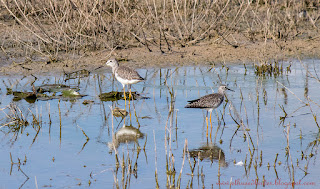
Greater & Lesser Yellowlegs
(1/3200 @ F/8) ISO 1000 250mm)


© Julian Moore  - birdingbarbados@gmail.com
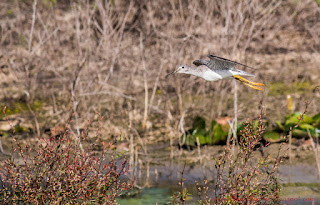
Lesser in flight (1/2500 @ F/8) ISO 1000 250mm)


© Julian Moore  - birdingbarbados@gmail.com
Little Egret in flight (1/5000 @ F/8) ISO 1000 250mm)

These are the birds I saw during the first week of March

  1.  Black-bellied Whistling-Duck - Dendrocygna autumnalis
  2. Blue-winged Teal - Spatula discors
  3. Green-winged Teal - Anas crecca
  4. Pied-billed Grebe - Podilymbus podiceps
  5. Scaly-naped Pigeon - Patagioenas squamosa
  6. Eurasian Collared-Dove - Streptopelia decaocto
  7. Common Ground Dove - Columbina passerina
  8. Sora - Porzana carolina
  9. Common Gallinule - Gallinula galeata
  10. American Coot - Fulica americana
  11. Least Sandpiper - Calidris minutilla
  12. Wilson's Snipe - Gallinago delicata
  13. Spotted Sandpiper - Actitis macularius
  14. Solitary Sandpiper - Tringa solitaria
  15. Greater Yellowlegs - Tringa melanoleuca
  16. Lesser Yellowlegs - Tringa flavipes
  17. Laughing Gull - Leucophaeus atricilla
  18. Royal Tern - Thalasseus maximus
  19. Red-billed Tropicbird - Phaethon aethereus
  20. Brown Booby - Sula leucogaster
  21. Great Egret - Ardea alba
  22. Little Egret - Egretta garzetta
  23. Snowy Egret - Egretta thula
  24. Little Blue Heron - Egretta caerulea
  25. Cattle Egret - Bubulcus ibis
  26. Green Heron - Butorides virescens
  27. Merlin - Falco columbarius
  28. Gray Kingbird - Tyrannus dominicensis
  29. Caribbean Martin - Progne dominicensis
  30. Carib Grackle - Quiscalus lugubris
  31. Grassland Yellow-Finch - Sicalis luteola
  32. Bananaquit - Coereba flaveola  


Saturday, 27 February 2021

Barbados CWC 21 Synopsis

Pied-billed Grebe - one of the waterbird species  @ Walkers Reserve

The whole world is at a standstill because of the COVID pandemic.  Traveling between countries has all but ceased as many countries are closing borders.  Not everyone was affected, or should I say not everything, because there are a few thousand nomads whose sojourn across the globe has continued unabated. Using ancient highways in the sky, virtually unnoticed by the masses, except for a few who made it their business to notice, to document, and to find ways to assist these travelers.
Of course, the travelers we are speaking of are birds, migratory birds.  While these continue to travel from their breeding grounds to feeding grounds and back unaffected by the pandemic, for years their numbers have continued to decline, and none more so than that of waterbirds.   Waterbirds refer to birds that live on or around water, especially freshwater.  This includes shorebirds, ducks, herons, and egrets, to mention a few.  This family of migrating birds continue to suffer from the effects of climate change and loss of habitat.  To truly understand the impact and be able to provide targeted and effective solutions, data is needed.  Accurate data is the foundation of good decision-making and in our part of the world, many tools are being used to collect data.   One such tool is the Caribbean Waterbird Census (CWC).   This “multi-partner region-wide waterbird and wetland monitoring program [is] led by Birds Caribbean”, whose mandate among other things is to conserve “bird populations and [their] ecosystems.”

John all geared up for the count

The birders of Barbados were happy to be part of the 2020/21 survey.  Dr. John Webster and I were involved in surveying several targeted sites across the island between August 15 to October 15, 2020, the peak fall migration period, and from January 14 to February 3, 2021.  We visited these sites on multiple occasions recording the birds seen there and the quality of the site - (water levels, vegetation, food availability, or anything that could impact the birds stopping, resting, or feeding there).  We also recorded such things as, the time of day we visited, the temperature, weather conditions, wind direction, and intensity. This created a snap shot of each visit and in time would be able to highlight any trends. This got us out in the field and visiting these locations more often than we normally would. 

American Coot family at Walkers Reserve, St. Andrew

The highlight of the event, no doubt, would have been the recording and monitoring of the recommencement of the nesting of American Coots (Fulica americana)(white shielded) originally known as Caribbean Coot, on the island.  We saw many failed attempts at nest building during the first part of the survey, between August to October but were happy to record two pairs with chicks at one location and a nesting pair at another location during January. 

The Ruff seen at WSR during the CWC

Ruff 
(Calidris pugnax) at Woodbourne Shorebird Refuge (WSR) was also a good find.  This Eurasia vagrant was seen on October 10th, 2020. 

Barbados, because of its isolated location in the Atlantic is an important link in the yearly migratory route of many birds.  How much so and how can we assist in making the travels of these regional and international nomads safer?  The data collected by programs like the CWC could help provide the answers.  We look forward to future CWC events, with the hope of expanding to other sites and eventually getting more persons involved as we seek to create a safe path for the Birds of Barbados, the region, and the world. 

Notables and images from the CWC

location: Chancery Lane Swamp, Christ Church 
  • 31 Whimbrels (Numenius phaeopus) - September 7th
  • Willets (Tringa semipalmata) - August 24th
  • 25 American Golden - Plover (Pluvialis dominica) - September 22nd
  • 21 Lesser Scaup (Aythya affinis) - January
  • 4 species of ducks -
    • Blue-winged Teal (Spatula discors)
    • American Wigeon - (Mareca americana)
    • Ring-necked Duck (Aythya collaris)
    • Lesser Scaup (Aythya affinis)

A fraction of the 31 Whimbrels  

 Lesser Scaups in January

Location: Woodbourne Shorebird Refuge

Lesser Scaup

  • Ruff (Calidris pugnax) -October 10th, 2020
  • 5 species of ducks in January:
    • Black-bellied Whistling-Duck(Dendrocygna autumnalis) with Ducklings
    • Blue-winged Teal (Spatula discors)
    • Green-winged Teal  (Anas crecca)
    • Ring-necked Duck (Aythya collaris)
    • Lesser Scaup (Aythya affinis)


Location: North Point, St. Lucy
  • 2 Buff-breasted Sandpiper (Calidris subruficollis) October 
  • Collared Plover (Charadrius collaris)
  • 111 Semipalmated Sandpiper (Calidris pusilla) September 16th
  • 17 species of shorebirds
Least Sandpiper

Location Walkers Reserve, St. Andrew
  • 2 pairs of American Coots (Fulica americana)(white shielded) with a total of three chicks and one bird building a nest.

American Coots taking material for nest making


Friday, 12 February 2021

The Barbados Birds and Birding Report – January

The first month of the year went by pretty fast and even though it was not a normal month, due in part to the increasing spread of COVID in the society, the local birders tallied seventy-five species.  

January Rare Bird Sightings

Here is a list of Rare Birds seen during the last month parish by parish (*continuing Birds)

St. Lucy


  • Glossy Ibis (Plegadis falcinellus) (1)* a high count of three birds was seen at this location throughout last year, one of which has been around since August 2019. Only one bird was seen during the limited visits to this location in January;
  • American Coot ((White Shielded) Fulica Americana) A juvenile, most likely hatched at this location, this is a very big deal.

  • Purple Gallinule (Porphyrio martinica)* – an adult and a juvenile bird was seen at a private location. The adult most likely is the same bird seen at this location late last year

  • Ruddy Duck (Oxyura jamaicensis)* - a single bird first seen on December 29thremained into the new year.
  • Fulvous Whistling-Duck (Dendrocygna bicolor)* seen with a family of Black-bellied Whistling-Ducks (Dendrocygna autumnalis)
  • Long-billed Dowitcher (Limnodromus scolopaceus)* two birds held over from last year

 St. Andrew 

  • American Coot ((White Shielded) Fulica Americana) (6)*, 5 at The Walkers Reserve. Finally, we can confirm nesting of at least 2 pairs with a total of 5 chicks at this location. This is a big deal!

St.Philip

  • Grey Heron (Ardea cinerea) this yearly Eurasian visitor was seen on the 30th 
  • Glossy Ibis (Plegadis falcinellus)* this very active bird appears to move between 2 locations in Christ Church, one being Woodbourne Shorebird Refuge (WSR) and a private impoundment in this parish.
  • Snail Kite (Rostrhamus sociabilis)* this bird appears to be expanding its range from its roosting location at Bay Street, St. Michael
Christ Church

  • American Wigeon (Mareca Americana)* first seen last month, was reported early in the month but was not seen after that.
  • American Coot (Fulica Americana)* – a high count of three birds seen with one appeared to be nesting.
  • Yellow-crowned Night-Heron (Nyctanassa violacea) The rarer of the two night herons that can be found on the island, this one was seen and photographed by Carla Daniel of the Barbados Turtle Project on Dover Beach.
  • Glossy Ibis (Plegadis falcinellus)* - seen at WSR on the 25th but relocated to another location in the parish of St. Philip.
St. Michael

  • Snail Kite (Rostrhamus sociabilis)* Still at Bay Street but is extending its range to other wet lands.
  • Brown Pelican (Pelecanus occidentalis)  at Pile Bay

Feel free to contact me, Julian Moore @ 100birdsbarbados@gmail.com, John Webster @ barbadosbirds@gmail.com, or Ed Massiah @ ebmassiah@hotmail.com to report any rare bird sightings, or if you need assistance identifying a bird, we would be happy to help. 

Tuesday, 19 January 2021

Banded Sanderling at Six Men's


Barbados had its first banded bird sighting for the year, a Sanderling (Calidris alba) with tagged markings JK>.  It was first seen and photographed by a local photographer Himal Reece at Six Men’s, St. Peter.  I saw the bird on Saturday, January 16th, at the same location with 10 others Sanderlings and a Ruddy Turnstone (Arenaria interpres).  This no doubt, is just a remnant of a larger flock I saw there on December 5th which numbered close to 50 birds. The shorebird appeared healthy and was actively feeding, the only one in the group doing so, the others were at rest.  The sighting was reported to www.bandedbirds.com
Six Men’s Bay is one of the wintering locations for Sanderlings on the island and over the years there have been several resightings there. See a list below of the tag IDs, the year and location of its banding, and the year of resighting at Six Men’s Bay.

  • Y2L was tagged on May 22, 2015, at Villas Beaches, New Jersey, United States. Resighted at six Men’s in 2012, 2013, 2014, 2015 and 2020

  • 19Y was tagged May 22, 2014, at  Villas Beaches, New Jersey, United States - Resighted at Six Men’s in 2014

  • CVE was tagged on  May 22, 2015, at Villas Beaches, New Jersey, United States - Resighted at Six Men’s in 2015 and Long Beach, Christ Church in 2018.

  • JK>  was tagged on May 5, 2019, at Kimbles Beach - South, New Jersey, United States – Its resighting history is very short  -

  • 5/24/2019 - Reeds Beach - south, New Jersey, United States  
  • 5/30/2019 - Kimbles Beach - north, New Jersey, United States
  • 6/1/2019 - Villas Beaches, New Jersey, United States
  • 7/29/2019 - Moores Beach - Creek, New Jersey, United State 
  • 1/3/2021 – Six Men’s Bay, St. Peter, Barbados

Banding data is useful in both scientific research, species management and conservation projects. The individual identification of birds makes possible studies of dispersal and migration, behavior and social structure, life-span and survival rate, reproductive success, and population growth.  When such data is reported, it helps in connecting parts of the puzzle that is the bird's life and journeys.  It allows for important conservational resources to be plugged in at the most effective areas for the betterment of the targeted species. So next time you happen to see a banded bird report it, share the information, look it up on www.bandedbirds.com.  It may give you a new appreciation for our feathered friends. 

Stay safe and enjoy your birding


Sunday, 3 January 2021

The Barbados Birds and Birding Report – December

The last month of 2020 brought with it many birds and birding opportunities.  The influx of ducks that we started seeing at the end of last month amplified into this month.  In December seven birders submitted over 70 checklists to ebird with over 59 species, with an American Wigeon (Mareca Americana) at Chancery Lane Swamp, Christ Church, being the only new addition to the islands 2020 list.  We can now say Barbados has recorded 115 different bird species for the year 2020.

Ducks and more Ducks

Lesser Scaups

The number and species of migratory ducks increased immensely during the month of December. Blue-winged Teal (Spatula discors), our most numerous migratory ducks, was present at many locations right across the island with a high count of 138 birds at The Woodbourne Shorebird Refuge (WSR) on December 7. The WSR continued to be the favorite landing spot for ducks with its playing host to several species, Lesser Scaups (Aythya affinis) (11),  Green-winged Teals (Anas crecca) (4), Ring-necked Ducks (Aythya collaris) (3) and a breeding group of Black-bellied Whistling-Ducks (Dendrocygna autumnalis) (20+).  Other than the WSR we also had a high count of 20 Lesser Scaups (Aythya affinis) at Chancery Lane’s Swamp, and one at a location in St. Lucy.  The Lane was also the only location for an American Wigeon (Mareca Americana), which was seen swimming at a group of 8 Blue-winged Teal (Spatula discors) and 3 Ring-necked Ducks (Aythya collaris).  A Fulvous Whistling-Duck (Dendrocygna bicolor) put in a late appearance in the duck-fest, when a signal bird was seen in St. Lucy.  I am expecting to see more ducks arriving in January.

December Rare Bird Sightings

2020 has been a difficult year for many and as we roll over into 2021 I hope you will have a wonderful year as we continue to adjust to the changes caused by COVID.  Here is hope you’ll have a wonderful and productive 2021.  May all your nemesis birds become lifers and all your dream locations become just sidenotes. Stay safe and enjoy your birding,

Here are the rare birds seen during the month, highlighted below parish by parish. (* continuing Birds)

St. Lucy

  • Glossy Ibis (Plegadis falcinellus) (2)* The first bird has been around since August 2019, it was joined by another in August and another one in September but now only two birds remain at this location with one of them molting to breeding plumage.
    American Coot

  • American Coot ((White Shielded)* Fulica Americana) bird first seen by John Webster.
  • Killdeer (Charadrius vociferous)* - expect at this time of the year.  this one was first seen by Ed Massiah at  North Point on the 30th
Long-billed Dowitcher
  • Long-billed Dowitcher (Limnodromus scolopaceus)* - One of the most difficult shorebirds to identify because of its similarities to the more common Short-billed Dowitcher (Limnodromus griseus). John Webster was able to locate and identify these two by their call. 
Fulvous Whistling-Duck
  • Fulvous Whistling-Duck (Dendrocygna bicolor) this bird returns to the island yearly around this time.
  • Purple Gallinule (Porphyrio martinica)- this species was seen at this location around this time last year.  This maybe the same bird returning to the same location

 St. Andrew 

  • American Coot ((White Shielded) Fulica Americana) (6)*, 5 at The Walkers Reserve, and 1 at Bawdens. These birds were there for more than a year, nesting expected. 
  • American Coot ((Red Shielded) Fulica Americana)* the rarer of the two American Coots, continue at The Walkers Reserve

St. Philips

  • Purple Gallinule (Porphyrio martinica) seen a day before the one recorded in the parish of St. Lucy, maybe a suggestion that this species is in the process of migrating
  • Red-billed Tropicbird (Phaethon aethereu) an earlier than a normal visit by a birder to the nesting area highlighted 4 birds

 Christ Church

  • Brown Pelican (Pelecanus occidentalis)* seen at Oistins sitting on a buoy in the Bay.
    Glossy Ibis

  • Glossy Ibis (Plegadis falcinellus)* - This bird was seen at a location in this parish but relocated to a private location in St. Philip in the latter half of the month
  • Prothonotary Warbler (Protonotaria citrea) seen at the Graeme Hall Swamp
  • American Coot ((White Shielded) – 2 at Chancery Lane 

St. Michael


Snail Kite

  • Snail Kite (Rostrhamus sociabilis)* - our star raptor is still here at Bay Street on its usual perch looking for red crabs. (see this) It has extended its range with one sighting in St. Philip at the end of the month.
  • Brown Pelican (Pelecanus occidentalis) - seen at Pile Bay multiple times during the month


Feel free to contact me, Julian Moore @ 100birdsbarbados@gmail.com, John Webster @ barbadosbirds@gmail.com, or Ed Massiah @ ebmassiah@hotmail.com to report any rare bird sightings, or if you need assistance identifying a bird, we would be happy to assist. 

Friday, 4 December 2020

The Barbados Birds and Birding Report – November

White-winged Tern

Migration slowed but birds were still on the move.  During November, six birders submitted 63 checklists to ebird.org, for a total of 69 species, with a White-winged Tern (Chlidonias leucopterus) and a Ruddy Duck (Oxyura jamaicensis) being first records for the year, moving the island's tally to 113 species. (112 reported to ebird, 1 unreported) 

Migratory ducks arrived and continued throughout the month of November.  Over 100 Blue-winged Teals (Spatula discors), our most numerous migratory duck, were reported at locations in the east and the north, with smaller amounts at other ponds.  Accounts of the closely related duck species, Lesser Scaup (Aythya affinis) and Ring-necked Duck (Aythya collaris) at two locations in the south and east, also a Ruddy Duck (Oxyura jamaicensis) in St. Lucy added to the influx of ducks.

November  Rare Bird Sightings

Several rare birds showed well during November but the two highlights, because of the number of birds seen, were five Brown Pelican (Pelecanus occidentalis) and four juvenile Lesser Black-backed Gull (Larus fuscus) at Pile Bay St. Michael on the 9th.  Other rare birds seen during the month are highlighted below parish by parish. (* continuing Birds)

St. Lucy

  • Glossy Ibis (Plegadis falcinellus) (3)* The first bird has been around since August 2019, it was joined by another in August and another one in September
  • American Coot ((White Shielded)* Fulica Americana) bird first seen by John Webster during the October Big Day.
  • Bobolink (Dolichonyx oryzivorus)*- A few hanged around last into the month with John Webster reporting one on the 20th
  • Hudsonian Godwit (Limosa haemastica)* – one bird remaining from last month

  • White-winged Tern 
    (Chlidonias leucopterus) - First seen at a private location but then relocated to the wet area at North Point. (See this)
  • Killdeer (Charadrius vociferous) - expect at this time of the year.  this one was first seen by Ed Massiah at  North Point on the 30th

  • Long-billed Dowitcher
    (Limnodromus scolopaceus) - One of the most difficult shorebirds to identify because of its similarities to the more common Short-billed Dowitcher (Limnodromus griseus). John Webster was able to locate and identify these two by they call. 

  • Ruddy Duck
    (Oxyura jamaicensis) - a single bird seen on the 
    29th
St. Andrew 

  • American Coot ((White Shielded) Fulica Americana) (6)*, 5 at The Walkers Reserve, and 1 at Bawdens. These birds were here for more than a year, nesting expected. 
  • American Coot ((Red Shielded) Fulica Americana)* the rarer of the two American Coots.  This bird is paired with one of the White Shielded mentioned above at Bawdens.

Christ Church

  • Brown Pelican (Pelecanus occidentalis)* seen at the Board Walk at Hasting and Oistins during the month.
  • Glossy Ibis (Plegadis falcinellus)* - This is the fourth Glossy on the island 

St. Michael

  • Snail Kite (Rostrhamus sociabilis)* - our star raptor is still here at Bay Street on it usual perch looking for red crabs. (see this)
  • Lesser Black-backed Gull (Larus fuscus) - five of these large gulls continue at Pile Bay, all juveniles.
  • Brown Pelican (Pelecanus occidentalis) - Five of our national bird were seen between Pile Bay and Payne's Bay, St. James 
St. James

  • Brown Pelican
    (Pelecanus occidentalis) - two birds seen sitting on a boat and one flying around
 

Feel free to contact me, Julian Moore @ 100birdsbarbados@gmail.com, John Webster @ barbadosbirds@gmail.com, or Ed Massiah @ ebmassiah@hotmail.com to report any rare bird sightings, or if you need assistance identifying a bird, we would be happy to assist.