Sunday, 27 September 2020

Birds, Turtles and Dead Fish at Silver Sands

Tricolored Heron

The plan was simple, leave home early to do a count at Chancery Lane Swamp for the Caribbean Waterbird Census (CWC), and get back home before 9 am.  Simple!  It was going to plan until I saw a Tricolored Heron (Egretta tricolor) as I drove past the estuary at Silver Rock, Christ Church.  I stopped and the first thing that I noticed was a stench, a really bad stench.  

Dead Fish
As I approached the water I saw the source of the smell, hundreds of dead fish were lining the bank and sick ones in the water. The water was still full of life, lots of healthy looking fish of all ages, thousands of Cane Toad (Rhinella marina) tadpoles feeding on the dead fish, and even more, toadlets were on the banks of the inlet.  Along with the Tricolor, were five juvenile Laughing Gulls (Leucophaeus atricilla) feeding on the fish,  and a few shorebirds - Semipalmated Plovers (Charadrius semipalmatus), Semipalmated Sandpipers (Calidris pusilla), and Spotted Sandpiper (Actitis macularius), feeding on the banks.  While photographing the heron I noticed a hatchling Green Turtle  (Chelonia mydas) stuck in some of the vegetation around the pond and then I found another and another until I had five of these beauties in my clutch.  I contacted Carla Daniel of the Barbados Sea Turtle Project and within minutes, she was on the scene and finding more hatchlings (you can see her video here ). 

In her search, she came across a dead Semipalmated Sandpiper and too sick Semipalmated Plovers.  The other birds in the area appeared healthy, even the gulls which were feeding on the fish.  Unsure of which government entity was responsible for these bodies of water and the quality of them, I reported our findings to both the Ministry of the Environment and the Coastal Zone Management Unit.

I knew that Cane Toads were toxic but I was unsure about the toxicity of the tadpoles and toadlets.  I found a 2015 paper by The Australian Threatened Species Scientific Committee to the Department of Agriculture, Water and the Environment intitled The biological effects, including lethal toxic ingestion, caused by Cane Toads (Bufo marinus) which stated that  “All stages of the Cane Toad's life cycle: eggs, tadpoles, toadlets, and adult toads, are poisonous”.  Can the dead and sick birds be the result of poison, from ingesting the toadlets and have nothing to do with the fish kill?  I am hoping to find the answer to that question.

I never got to  Chancery Lane Swamp for the CWC count and would try to fit it in sometime during the week. Let's hope no more birds are affected by whatever is going on at the Silver Rock estuary, it would be a tragedy for these long-distance travelers who are already under immense pressure. 

Other Images  

Green Turtle Hatchling
The 1st Green Turtle Hatchling I saw

Green Turtle Hatchling
More hatchlings

The final count by 
Barbados Sea Turtle Project : 25 Hatchlings

Laughing Gull
Juvenile Laughing Gull @ Silver Rock

Laughing Gull
Laughing Gull

Laughing Gull eating a fish


Friday, 25 September 2020

The Shorebirds Showed Up: A Successful Caribbean Shorebird Count for World Shorebirds Day


Caribbean shorebirds count in 2020! With growing threats to their habitats, perhaps now more than ever.

Our Caribbean partners went out “shorebirding” in their favorite spots between September 3 and 9, 2020, as part of the Global Shorebird Count. Despite some local challenges, the efforts of Caribbean birders were rewarded. Worldwidepreliminary results show 1,567checklists from 1,303 unique locations where 146 species of shorebirds were recordedThe official 2020 results summary results have not been posted yet but will appear on the World Shorebirds Day website. The Caribbean should be well represented. continue reading ...

Monday, 21 September 2020

Snail Kite - A New Bird Species For Barbados

Juvenile Snail Kite

Barbados has recorded its 273rd bird species - a Snail Kite (Rostrhamus sociabilis)(Clements Checklist v2019 / Avibase) . The juvenile bird was seen and recorded on video at Bay Street, St. Michael by a resident, who shared the video with local birders.  I visited the area on the 8th and had no problem locating the bird, which was very tolerant of pedestrian traffic.  What was even more surprising than finding this bird was seeing what it was eating.  As its common name suggested this bird feeds mainly on snails,  an aquatic species of snail called Apple Snails to be exact, a snail not common to our island, if present at all.

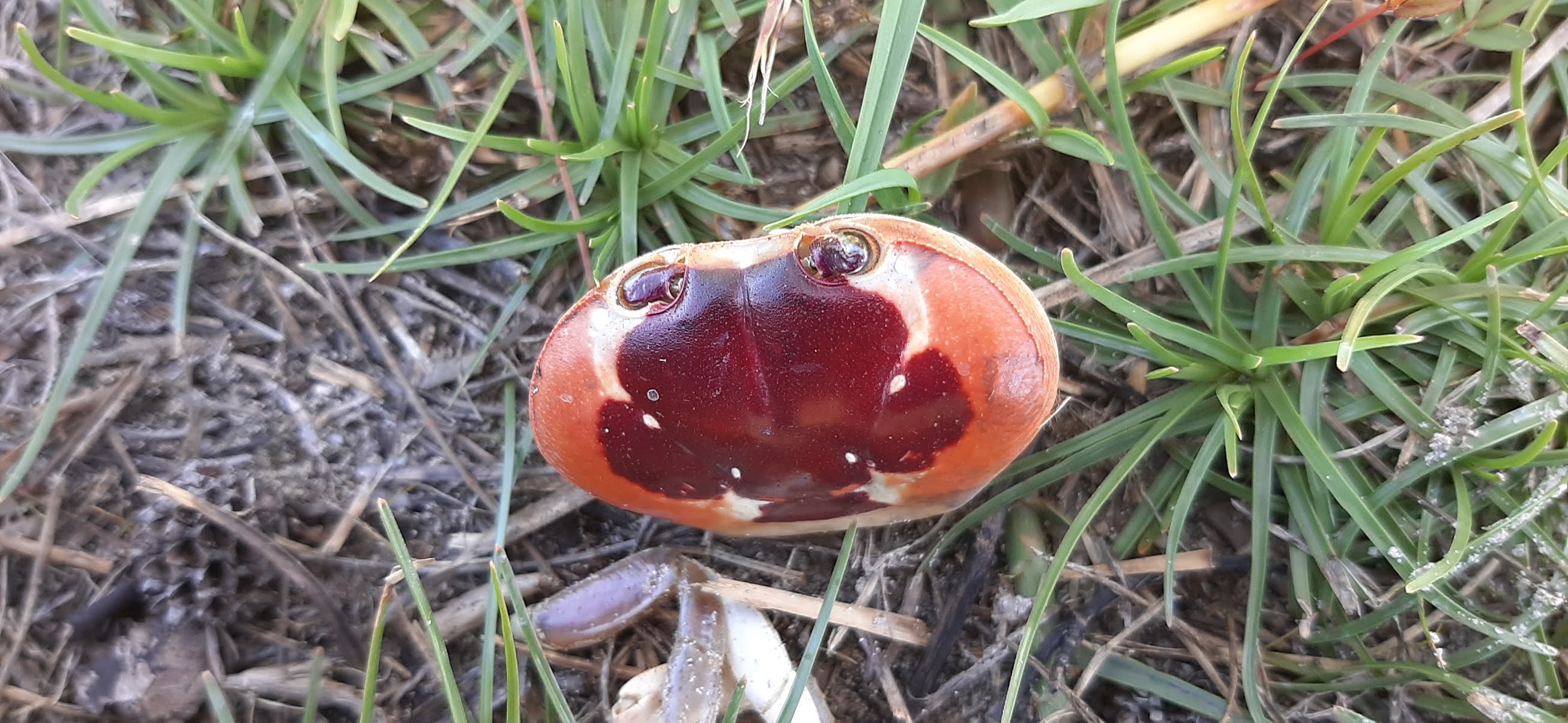
Top of eaten Blackback Land Crab
underneath eaten Blackback Land Crab

The bird was feeding on Blackback Land Crabs (Gecarcinus lateralis) and as the images above shows, was efficiently doing so.


The Snail Kite is a medium-sized hawk about 14 - 19” (36 - 48 cm) in length with a long, broad, and rounded wings which are 39–47” (99–120 cm) in width. It has a long, squared-off tail, synonymous with kites, and a dark tipped very hooked beak.  Females and Juveniles, like this one, shows dark brown upperparts, while it is heavily streaked underneath, with the adult female having more of a white base, a field marking being a super bright supercilium or eye brow, while the juvenile base color is more yellowish.  The legs are mainly yellow.  The male Snail Kite is a striking fellow, dark grey all over, with red eyes, bill base, and legs.

This bird most likely arrived from South America, which is the closest range of these birds to Barbados, but there is also a Caribbean breeding population in Cuba and also one in Florida, USA.

We will continue to monitor and document this bird, another first for Barbados, and give updates on any changes.

Stay safe and enjoy your birding.

Wednesday, 2 September 2020

The Barbados Birds and Birding Report – August

Chancery Lane Swamp
Rain, rain and more rain – that was the theme for August.  The rainy conditions that broke the drought at the end of July continued into August and it brought many wet areas alive with water and birds. Three places that benefited were the old hunting Impoundment at North Point, St. Lucy, Woodbourne Shorebird Refuge (WSR) in St. Philip, and Chancery Lane Swamp in Christ Church, each hosted a significant bird or birding episode that warranted inclusion in this months report. Let's look at the highlights for August.

Birds and Birding for the Month

In August a whopping 91 checklists were created and forwarded to ebird.org, containing 60 species, and six birds were added to the Barbados 2020 checklist. These were Cliff Swallow (Petrochelidon pyrrhonota),  White-rumped Sandpiper (Calidris fuscicollis),  Pectoral Sandpiper Calidris melanotos, Least Tern (Sternula antillarum), and Yellow-crowned Night-Heron (Nyctanassa violacea). Three reasons for this jump in the number of submitted checklists are: (1)the availability of more areas for birds and birding because of the rains, (2) we are in the midst of the fall migration, so more birds to see, and (3)the island has been included in a conservation project to monitor the number of waterbirds at a few locations across the island, thus more frequent visits to these sites.  The program, which is headed by Birds Caribbean, is called the Caribbean Waterbird Census.   I will tell you more about it in another post. 
A few high counts of migrating birds were seen at various locations across the island
For example:
  • Semipalmated Sandpiper (Calidris pusilla), had a high count of 157 birds reported by John Webster at North Point, other significant counts were 152, 104, and 100 at other locations.
    Whimbrels @ Chancery Lane
  • Whimbrel (Numenius phaeopus) a high of 28 birds at Chancery Lane, also 6 birds at North Point.
  • Glossy Ibis (Plegadis falcinellus) sightings of this bird were reported in St. Michael, St. Philip, St. Thomas, and an additional one in the north joining with the one that was there for over a year.   

August Rare Bird Sightings

Here is a list of Rare Birds from last month listed by Parish  (* continuing Birds)
St. Lucy
  • Glossy Ibis (Plegadis falcinellus) (2)* This bird has been around since August 2019, but a visit to the location in the north on the 7th found that this bird now has a companion.
    Least Tern
  • Least Tern (Sternula antillarum) was first reported on 27th by Niels Larsen at North Point.
St. Andrew
  • American Coot ((White Shielded) Fulica Americana) (6)*, 5 at The Walkers Reserve, and one at Bawdens.
  • American Coot ((Red Shielded) Fulica Americana)* the rarer of the two American Coots.  This bird is paired with one of the White Shielded mentioned above at Bawdens.
St. Thomas
  • Glossy Ibis (Plegadis falcinellus) seen flying over the recycle plant at SBRC, Vaucluse.
St. Philip
Glossy Ibis
  • Glossy Ibis (Plegadis falcinellus) one bird seen at Woodbourne Shorebird Refuge (WSR) on the 28th.
  • Purple Gallinule (Porphyrio martinica) at WSR on the 28th.

Christ Church
  • Yellow-crowned Night-Heron (Nyctanassa violacea) was seen by two none birders at Enterprise Beach.  A Whatsapp image was sent to me to be identified.
  • Sandwich Tern (Thalasseus sandvicensis). This bird was seen at Inch Marlow feeding with Royal and Roseate Terns.
    Brown Pelican
  • Brown Pelican (Pelecanus occidentalis)* this bird was seen by many persons between the areas of Inch Marlow and Oistins.
St. Michael
  • Glossy Ibis (Plegadis falcinellus) briefly tried to join the Cattle Egret (Bubulcus ibis)  rookery at John Beckles Drive, Bridgetown before aborting the attempt and moving on. This may be the same bird seen at WSR.
 Feel free to contact me, Julian Moore @ 100birdsbarbados@gmail.com, John Webster @ barbadosbirds@gmail.com, or Ed Massiah @ ebmassiah@hotmail.com to report any rare bird sightings, or if you need assistance identifying a bird, we would be happy to assist.

Sunday, 30 August 2020

Two Rare Birds and Baby Ducks at WSR

Shorebirds @ WSR
Since the rains came, Woodbourne Shorebird Refuge (WSR) have been a hive of activity.  Even though its at less than 30% of its water capacity, it is still attracting lots of birds, even rare ones.

Glossy Ibis
  On the 28th a Glossy Ibis (Plegadis falcinellus) and a Purple Gallinule (Porphyrio martinica), both rare birds, were recorded there. 
Black-bellied Whistling-Ducks Ducklings
Along with a clutch of 11 Black-bellied Whistling-Ducks (Dendrocygna autumnalis) in the back swamp.  A high count of over 100 Semipalmated Sandpipers (Calidris pusilla) was tallied in the tray in front of the lookout.  All in all the WSR is shaping up to have a busy fall migration, lets hope for more rain to get it to at least 50% of its water capacity.

Tuesday, 25 August 2020

Upcoming Birding Events

If you're looking to start your journey into this intriguing world of birding, ebirding, and citizen science, here are three upcoming events to look out for.  There are  The Global Shorebird Counts, September 3rd – 9th, and The Cornell Labs October Big Day 2020 on October 17th.

Global Shorebird Counts September 3-9


What is it:  The Global Shorebird Counts is an annual week-long event held around World Shorebirds Day which is celebrated yearly on 6 September.  It is used, in part, to draw attention to the continuing decline of shorebirds across the world due to such things as habitat loss, hunting, and climate change.  It also strives to raise public awareness of the need for continued shorebird research, monitoring, and conservation and to connect people with shorebirds through wetland sites around the world.
How to participate: By getting out to your local beaches, parks or wetlands during the week of the Global Shorebird Counts, especially on September 6th World Shorebirds day, count the shorebirds you see, enter the results of your count on ebird.org, share the checklist with World Shorebirds Day and that’s it.  See the 4 steps how-to here.

What is it:  It is an occasion when birders from across the world join together on October 17, to count and record as many birds as possible in a day.  In 2019 over 20,000 persons, in 170+ countries saw and reported just over 6,700 bird species, of which 49 was submitted by the 4 birders that took part locally.  This year can we double the participants to 8 persons and try for 60 species?
How to participate:  Follow this link to see how to


We are living in the time of COVID 19, so while we are excited and eagerly looking forward to these upcoming birding events just remember safety first.  Practice Social Distancing even when out in the field, becareful when sharing equipment, like your scope, camera, and bins – remember your eyes are one of the entry points for this virus, but most importantly and always practice common sense. Stay safe and enjoy your birding.

Wednesday, 19 August 2020

WSR Alive With Shorebirds


I made a few passes by one of the islands Important Birding Areas and first shorebird sanctuary, Woodbourne Shorebird Refuge (WSR),  Like most of the wet areas that depend heavily on rainfall, it was suffering badly.  With the constant rains, we have been having over the last few days, that wetland is slowly coming alive.
After the day of rain on Monday 17th,  it was about 20 - 30% full but more importantly, it had attracted shorebirds, lots of them.   The numbers varied somewhat over the visits but in total  10 species of shorebirds were seen there thus far.


Here are the shorebirds recorded:
Pectoral Sandpiper @ WSR
  1. Semipalmated Plover (Charadrius semipalmatus)
  2. Stilt Sandpiper (Calidris himantopus)
  3. Least Sandpiper (Calidris minutilla)
  4. Pectoral Sandpiper (Calidris melanotos)
  5. Semipalmated Sandpiper (Calidris pusilla)
  6. Short-billed Dowitcher (Limnodromus griseus)
  7. Spotted Sandpiper (Actitis macularius)
  8. Solitary Sandpiper (Tringa solitaria)
  9. Greater Yellowlegs (Tringa melanoleuca)
  10. Lesser Yellowlegs (Tringa flavipes)

I am excited at seeing one of my favorite birding locations coming alive with birds, especially shorebirds. Knowing the present dangers that these small birds face during migration it is heartwarming to see them at this oasis of safety.