Friday, 7 October 2022

A Big Weekend of Birding

October Big Day

Global Bird Weekend 7-9th


The weekend starting October 07th, will be a big weekend of birding worldwide. This is because birders from across the globe will come together for two major birding events, the October Big Day, on the Saturday 8th, and the Global Bird Weekend, starting Friday the 7th right through to Sunday the 9th.  (Click the above links for more).

In 2020 the island recorded its highest species count for this weekend of birding, 66 species. Last year we fell six species short of that total.  Can we surpass 66 species this year? You can help, How?  

Here is how to participate in the October Big Day:

  • Get an eBird account: eBird is a worldwide bird checklist program used by millions of birders. It’s what allows us to compile everyone’s sightings into a single massive Global Big Day list—while at the same time collecting the data to help scientists better understand birds. Sign up here. It’s 100% free from start to finish.
  • Watch birds on 8 October: It’s that simple. October Big Day runs from midnight to midnight in your local time zone. You don’t need to be a bird expert or go out all day long, even 10 minutes of birding from home counts.
  • Enter what you see and hear on eBird: You can enter your sightings via our website or download the free eBird Mobile app to make submitting lists even easier. Please enter your checklists before 12 October to be included in our initial results announcement.
  • Watch the sightings roll in: During the day, follow along with sightings from more than 190 countries in real-time on our October Big Day page.
Join us for the Big Weekend of Birding.

Friday, 16 September 2022

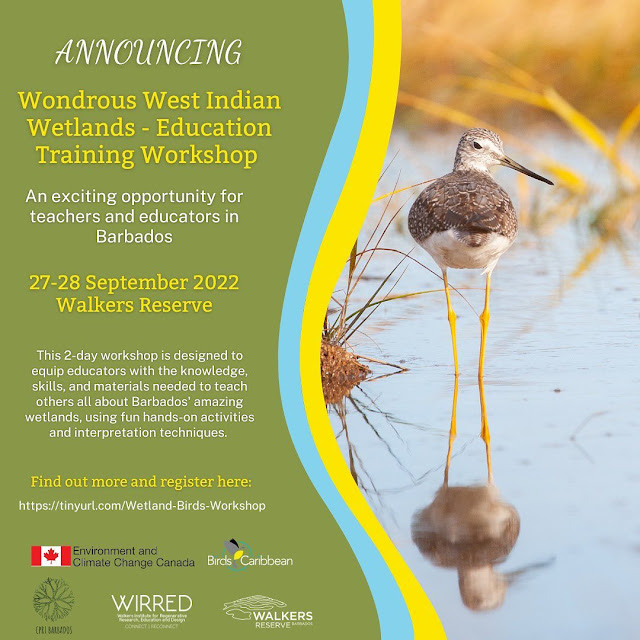
Birds Caribbean Wondrous Wetland Birds Workshop in Barbados

Calling all Educators and School-age Care Providers - Join our friends at @birdscaribbean and @cpribarbados for a 2-day Wondrous Wetland Birds Workshop on September 27th and 28th at Walkers Reserve, St. Andrew Barbados.


 This workshop is a train-the-trainer course focused on teaching you the importance of our wetlands and the birds that inhabit them. The workshop will equip educators, who work with learners of all ages (age 4 to postsecondary) with the skills, activities, and lesson plans to be able to pass on the knowledge.

For no cost, you will undergo 1 day of classroom learning @walkersreservebarbados where you will learn how to use the materials, practice the skills to teach the subject matter. On day 2 you will be taken on tours of popular wetland sites, taught how to identify different shoreline birds, and experience what an outdoor lesson would look like, amongst much more!

Saturday, 3 September 2022

The Barbados Birds and Birding Report – August

White-rumped Sandpiper one of the new birds for 2022
Barbados recorded its 100th bird species for 2022.  The bird was a Cliff Swallow (Petrochelidon pyrrhonota), which was seen at Inch Marlow, Christ Church on August 24th.  This was just one of five new bird species for the year. The others were: White-rumped Sandpiper (Calidris fuscicollis), seen in the parish of St. Lucy on the 1st, and a Bridled Tern (Onychoprion anaethetus) sitting on a fishing boat in the bay at Oistins on the 3rd, a Red Knot (Calidris canutus) joined the hundreds of shorebirds on Long Beach, Christ Church feeding among the sargassum Seaweed, and a rare Ruddy Duck (Oxyura jamaicensis) was seen by John Webster at Walkers Reserve, St. Andrew on the 23rd.

With a few days of Southernly winds predicted we may be in for a few rare birds in early September even as migration continues.  Of course, we will keep you up to date.

August’s Rare Bird Sightings

Here are the rare birds seen during the month, highlighted below parish by parish. (* continuing Birds)

St. Lucy

Six Glossy Ibis

  • Glossy Ibis (Plegadis falcinellus)(6)*- Last year December we saw 3 birds, then in January only one bird, as two of the 3 migrated but in August, 5 birds joined our loan bird;
    Fulvous Whistling-Duck
  • Fulvous Whistling-Duck (Dendrocygna bicolor)* – the lone duck that was seen last month was joined by another 2;
    Tricolored Heron
  • Tricolored Heron (Egretta tricolor)* seen in the first half of the month but no sighting during the latter half of the month;
  • Collared Plover (Charadrius collaris)*seen in the same area at North Point.

St. Andrew

  • Ruddy Duck (Oxyura jamaicensis) this stiff tail was seen by John Webster at Walkers Reserve on the 23rd.

Christ Church


Lesser Black-backed Gull
  • Lesser Black-backed Gull (Larus fuscus)* – This juvenile was with us for most of the year so far, which is rare in itself.  It is somewhat of a celebrity on some beaches with food, eg. sardines, being provided for it on regular occasions.  In this instance it was seen at the Oistins ice-pier instead of its usual stomping ground at Carlise's Bay;
Brown Pelican
  • Brown Pelican (Pelecanus occidentalis) was first seen at Oistins and then at Inch Marlow.

St. Michael

  • Lesser Black-backed Gull (Larus fuscus)* – seen at Carlise Bay.
    Snail Kite
  • Snail Kite (Rostrhamus sociabilis)* seen at its usual spot on Bay Street

Feel free to contact me, Julian Moore @ 100birdsbarbados@gmail.com, John Webster @ barbadosbirds@gmail.com, or Ed Massiah @ ebmassiah@hotmail.com to report any rare bird sightings, or if you need assistance identifying a bird, we would be happy to help.   

Friday, 26 August 2022

Birds of the Sargassum - Aerial Insectivores

A Caribbean Martin with an insect in its mouth
Another family of migrating birds that take advantage of the Sargassum Seaweed invasion is Aerial Insectivores.  These birds specialize in catching and feeding on insects while in flight.  Between 2018 and now, four of such species have been recorded at Inch Marlow and Long Beach, Christ Church with three of the four recorded there for the year.
The four species are, with the * indicating species already seen for the year:
  1. Caribbean Martins - Progne dominicensis*
  2. Bank Swallow aka Sand Martin - Riparia riparia
  3. Barn Swallow - Hirundo rustica*
  4. Cliff Swallow - Petrochelidon pyrrhonota*
The aerial insectivorous species that we saw first was the Caribbean Martins (Progne dominicensis).  These birds took advantage of this abundant food supply to feed their quickly growing chicks and to store fat in preparation for migration. (Read more about Caribbean Martins migration here)
Barn Swallow
Barn Swallows
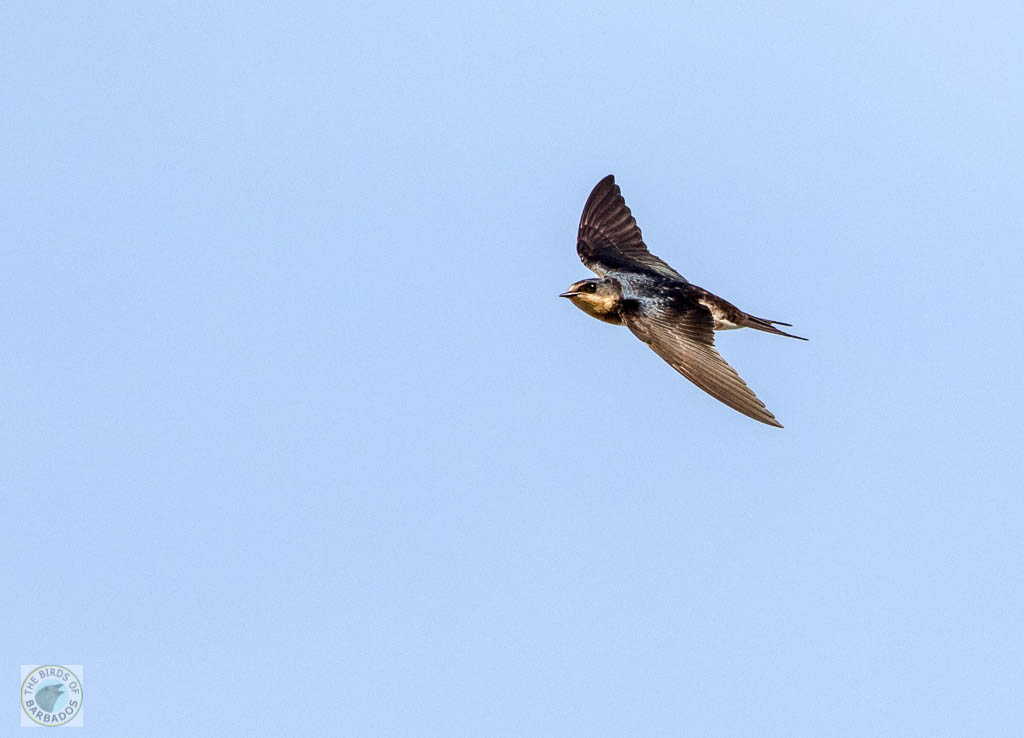
(Hirundo rustica) were the next species that arrived at Inch Marlow and Long Beach.  These are much smaller than the Martin and are very easy to differentiate between the two, but this is not the case with our third aerial insectivorous species that turned up to benefit from the food made possible by the Sargassum Seaweed Invasion.
Cliff Swallow
This species was the Cliff Swallow(Petrochelidon pyrrhonota). One put in an early appearance on Wednesday ( August 24th) among a flock of Barn Swallows but we should see a lot more next month September. 
The fourth, Bank Swallow (Riparia riparia) is not as common as the aforementioned species We historically see them in small numbers yearly and only on two recorded occasions at our highlighted locations feeding among the seaweed but we will keep an eye out for them.
The food source provided by the Sargassum Seaweed is a blessing for migratory birds, who continue to lose important feeding pit stops along their migratory flyways but it is not just these birds that benefit, local bird species also take advantage of this seasonal food supply.  I would highlight a few in the final part of this series Birds of the Sargassum. 


Tuesday, 16 August 2022

Birds of the Sargassum - The Shorebirds

Short-billed Dowitcher & a Semipalmated Sandpiper among the mountain of seaweed 
The Sargassum Seaweed invasion this year is terrible! I cannot remember the last time I saw so much seaweed on the shores.  Some of our famous white sandy beaches along the south and east coast are now covered with this gold and brown plant matter, and the stench from the rotting plant can be detected from miles away.  Over the last few years though, I've come to realize that this scourge to our shores has provided a much-needed food supply for birds, especially migratory shorebirds, and there is no better place to witness this than at Inch Marlow and Long Beach, Christ Church.  Between 2018 and now, I have seen about fifteen shorebird species at these locations feeding among the seaweed, and a tremendous amount of birds especially when bad weather is amidst.  Even though it is still early in the shorebird migration season nine species have already been detected there.  

There were:

  1. Semipalmated Plover - Charadrius semipalmatus
  2. Ruddy Turnstone - Arenaria interpres
  3. Whimbrel - Numenius phaeopus
  4. Least Sandpiper - Calidris minutilla
  5. Semipalmated Sandpiper - Calidris pusilla
  6. Short-billed Dowitcher - Limnodromus griseus
  7. Spotted Sandpiper - Actitis macularius
  8. White-rumped Sandpiper - Calidris fuscicollis
  9. Red Knot -  Calidris canutus

A Semipalmated Sandpiper disturbing the swarm of  flies attracted to the seaweed 

What are these birds finding to eat you may wonder.  While at sea, the Sargassum rafts provide housing and protection for various species of crustaceans, small fish, and even fish eggs.  Some are trapped in the seaweed as it comes ashore providing an easy meal for these birds.  Another food source presents itself as the seaweed rots.  It attracts flies, who lay eggs in the weed, which quickly becomes lava and a score of valuable protein for these migrants. 

There is no doubt that the Sargassum invasion is a menace to our beaches, beach life, and those living close to the sea but it is good to see a positive from it - providing a much-needed food source for this declining family of birds as there make their treacherous journey south.  If you get a chance go take a look at them feeding at Inch Marlow and Long Beach.

Shorebirds are not the only family of birds that take advantage of this food supply. As the weeks go on I will highlight a few more.

Stay safe and enjoy your birding!

Monday, 15 August 2022

Birds of the Sargassum - Images

Between 2018 and now I have seen about fifteen shorebird species at Inch Marlow and Long Beach, Christ Church feeding among the Sargassum Seaweed.  Here are a few images of some I saw this year. 

The two semis - Semipalmated Plover (L) and  Semipalmated Sandpiper (R)
Semipalmated Plover  standing on rotting seaweed with fresh golden ones in the background 
A Short-billed Dowitcher taking a drink 
Semipalmated Sandpiper foraging among the seaweed for crustaceans, small fish, or
even eggs 
 
A Semipalmated Sandpiper disturbing the flies attracted to the seaweed 
Semipalmated Sandpiper

Short-billed Dowitcher in flight
White-rumped Sandpiper
Spotted Sandpiper - Actitis macularius

Friday, 5 August 2022

The Barbados Birds and Birding Report – July

Red-footed Booby a rare bird seen in June 
I am happy to be presenting The Barbados Birds and Birding Report  after an absence of three months.  During that time the total species count for birds seen on the island this year moved from 87 to 95 species at the end of July. Here is a list of the new additions during the months, May to July:

  • July - Black-necked Stilt (Himantopus mexicanus), Collared Plover (Charadrius collaris), Brown Pelican (Pelecanus occidentalis);
  • June: Red-footed Booby (Sula sula), Roseate Tern (Sterna dougallii);
  • May: Fulvous Whistling-Duck (Dendrocygna bicolor), Striated Heron (Butorides striata), Black Swift (Cypseloides niger).

Stilt Sandpipers were one of the shorebird species migrating in  late July
The start of the southern migration became evident in July when we saw the subtle and not-so-subtle return of migrants.  One such event took place on the 17th when over 1000 Lesser Yellowlegs were recorded during a day of bad weather. Since then we have observable 2 to 3 smaller flights of  the same species, Least Sandpiper (Calidris minutilla), Semipalmated Sandpiper (Calidris pusilla), and Stilt Sandpiper (Calidris himantopus) in the weeks following. We also saw subtle signs of the return of Spotted Sandpipers (Actitis macularius) and Sanderlings (Calidris alba).

As we move into August we are expecting to see even more species of shorebirds and other birds passing through the island as the fall migration continues.

July’s Rare Bird Sightings

Here are the rare birds seen during the month, highlighted below parish by parish. (* continuing Birds)

St. Lucy


Glossy Ibis

  • Glossy Ibis (Plegadis falcinellus)(1)*- only one of the original three birds remaining at this location;
    Fulvous Whistling-Duck
  • Fulvous Whistling-Duck (Dendrocygna bicolor)*- A single bird was first seen on May 2nd with multiple sightings since then. This bird remained into the month of August;
    Tricolored Heron
  • Tricolored Heron (Egretta tricolor) - First appeared during the bad weather event on June 17 and remained into the month of August;
    Black-necked Stilt
  • Black-necked Stilt (Himantopus mexicanus) - The bird was first seen on the 8th and remained for two days before moving on;
    Collared Plover
  • Collared Plover (Charadrius collaris) - first seen  July 8th on the trail between Animal Flower Cave and the dilapidated  North Point Resort. This continued into the month of August.

Christ Church

  • Brown Pelican (Pelecanus occidentalis) - was first reported in the area of Atlantic Shores, later seen on a buoy off Enterprise Beach,

St. Michael

  • Lesser Black-backed Gull(Larus fuscus)* – is enjoying its long vacation here in Barbados. This bird has become a staple along the south .coast.  

Feel free to contact, Julian Moore @ 100birdsbarbados@gmail.com, John Webster @ barbadosbirds@gmail.com, or Ed Massiah @ ebmassiah@hotmail.com on use our Facebook Group to report any rare bird sightings, or if you need assistance identifying a bird, we would be happy to help.