Monday, 18 July 2022

It Rained Birds

Over 1000 Lesser Yellowlegs, like this one, passed through and over our island 
Last Saturday's morning downpour brought the first significant fall migration "flight". At 8:16am, I got the first clue that something magical was taking place when I got a Whatsapp message from a friend at a private sanctuary in the north of the island. It went like this, "Migration on today. Over 150 Lesser Yellowlegs (Tringa flavipes) in the swamp now".  A few images were also added to the message. 

Lesser Yellowlegs at a private sanctuary in the north
Then almost an hour later at 9:18am, one of our most experienced birders, who was at another private sanctuary in the east messaged,  "There is a flight ongoing for sure …never seen anything like this in all my years ...  Guys (at that location) reported several large flocks that overflew the swamp and went West…very unusual for this time of the migration". 

Yes, it was unusual.  Not that Lesser Yellowlegs were migrating because as I learned from a discussion on The Birds of Barbados Facebook page, a flight was expected. What was surprising, was the number of birds, it was as if it was raining birds.  

Sadly, with the shorebird hunting season starting just the day prior,  Friday 15th,  ... a violent but invisible blow blasted many of these weary travelers from the grey mournful skies.

It was reported that there was a significant lull from about 9am to just after midday and then flocks of Lesser Yellowlegs started to be seen again.

Tricolored heron (Egretta tricolor) in breeding plumage
At the end of the day, both sanctuaries at opposite ends of the island saw significant numbers of lesser Yellowlegs. The easterly one gave a conservative estimate of over 400 birds passing through or over that location. As if not to be outdone, the northerners tallied over 500 yellowlegs, but the exclamation of their day came late in the afternoon when there recorded a rare bird, a Tricolored heron (Egretta tricolor) in breeding plumage.  

While all of this action was taking place I was at home. I saw zero birds on that day as I was relegated to armchair birding, but from all accounts, Saturday's migration was unprecedented as no one, that is, persons with a combined experience of well over 100 years of observing birds,  can remember ever experiencing anything like this so early in the fall migration season.  It was a spectacle, it was as if it was raining birds.

Stay Safe and enjoy your birding 


Sunday, 10 July 2022

Four Rare Birds In One Afternoon Of Birding

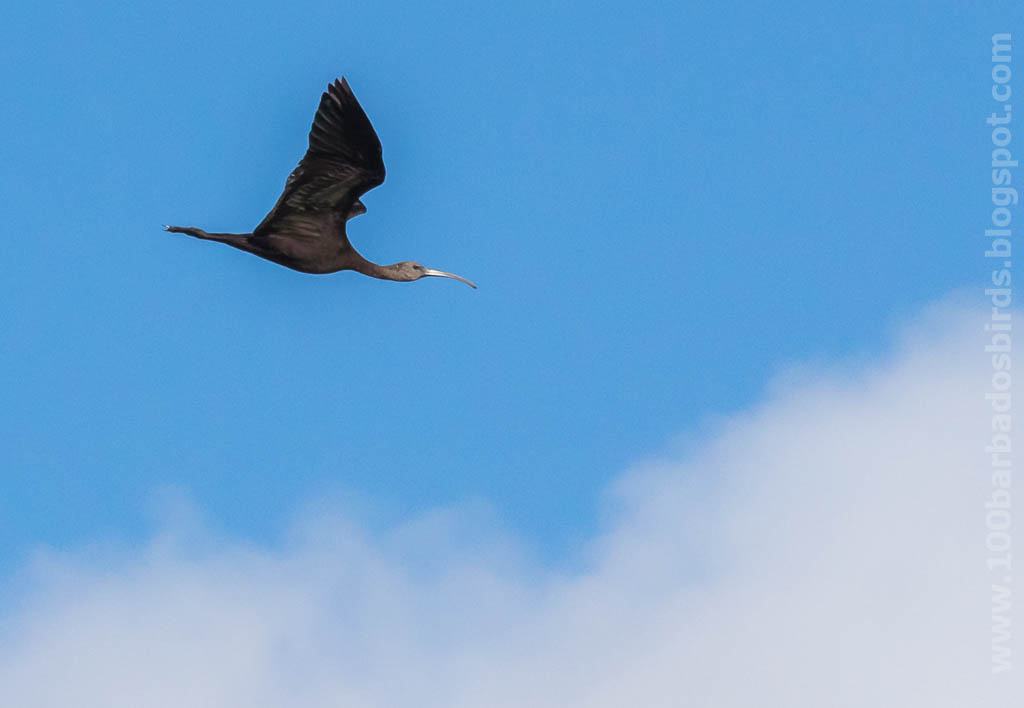
Glossy Ibis 
I started planning my birding weekend on about Wednesday. The plan was to go north to the rugged cliffs at North Point, St. Lucy.  History has shown that around this time of year that, that rocky, sea-blasted stretch of land attracts one of the smallest members of the  plover family, the Collared Plover (Charadrius collaris). Someone once wrote, “The best-laid plans of mice and men often go awry.” and that plan kinda went awry.  A short notice working commitment took me to the north, to Speightstown St. Peter to be exact, on Friday afternoon. I decided it would be wise, with gas prices so high, to kill two birds with one stone (I guess that may not be the best proverb for a blog about birds) and make the trip at the conclusion of my working commitment. That I did and it proved to be the right decision for two reasons: 1. It gave me more time birding, the Saturday trip was a peek and run, because of the limited time I had at my disposal but Friday afternoon gave me twice as much time to carefully look for my target bird. 2.  With the additional time I can now visit at least one more location in the north, which I did. On that Friday afternoon trip, I saw close to 30 species, including 4 rare birds, and it gave me birds 90 and 91 for my 110/10 Big Year Count.

90. Black-necked Stilt
My first stop was at a private impoundment, it was here I saw the first 3 rarebirds, two from previous months, a Fulvous Whistling-Duck (Dendrocygna bicolor) and a Glossy Ibis (Plegadis falcinellus) but then I saw my 90th year-bird. It was a Black-necked Stilt (Himantopus mexicanus).  These lanky black and white shorebirds stand at about 13.8–15.3"  (35–39 cm) and are irregular visitors to the island with one recorded successful breeding in 2011 at Walkers Reserve. 

91. Collared Plover
My second stop was to find my target bird, the Collared Plover, at North Point.  As I approached the location just south of the Animal Flower Cave, I was surprised by the ongoing construction of a solar farm.  It would be interesting to see how or if the none stop sea spray affect the plant.  The sea cliffs were covered in the fogged mist of the heavy sea spray, so after securing my camera in a protective covering, I began my needle in a haystack search for this tiny shorebird. As I walked along the trail heading south, I heard the distinct call of a Black-bellied Plover (Pluvialis squatarola) somewhere ahead of me, but I was unable to pinpoint the exact location.  As I continued along the trail, 6 of them flushed and took flight heading south while a smaller bird flew in the opposite direction and alighted a few 100 yards away among the rocky terrain.  With my binoculars I confirmed it to be my 91st yearbird a Collared Plover.  I spent a few minutes trying to get a few images in the fading light and was able to do so thanks to the 600mm reach of Big Selma, without getting too close to the bird.  This bird normally will hang around for a few weeks so I will try to relocate it, and hopefully, in more photographic-friendly conditions, try for Photographic Big Year images.  Of course, will have to start saving to afford the gas for my return trip but it was truly a refreshing trip to the north that Friday afternoon. 

See the total list below of the birds I saw.

Thursday, 23 June 2022

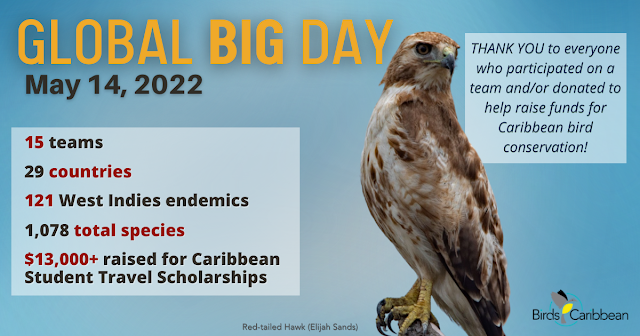
Global Big Day 2022: Birds Caribbean Continues Record-breaking Streak! by BC


Once again, on Saturday 14th May 2022 the Caribbean birding community showed up and showed out for Global Big Day! Global Big Day is an annual celebration of the birds around you. Birders and bird lovers across the globe spend the day observing and recording essential data about the birds they see. Some also take this opportunity to visit new birding spots, reconnect with colleagues, and tick lifers off their lists. 
continue read >>>


Thursday, 5 May 2022

The Barbados Birds and Birding Report – April

There were three new birds in April, one was a mega-rare. There were Pectoral Sandpiper (Calidris melanotos), American Oystercatcher (Haematopus palliates), the mega-rare bird, and Willet (Tringa semipalmata), bringing the total birds species seen at the end of April to 87.

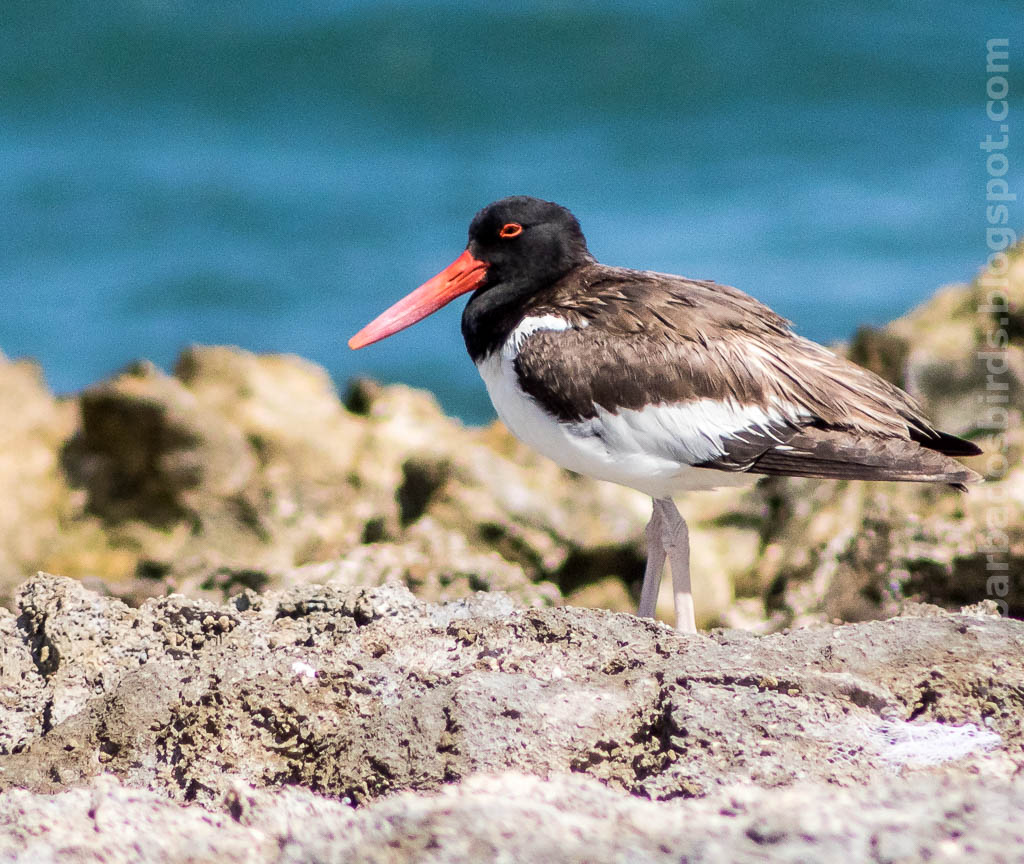
American Oystercatcher (Haematopus palliates) are large, stocky shorebird, about 17-21” (38-21cm) in length, with a long, bright reddish-orange beak, yellow iris, and a bright reddish-orange eye-ring.  The last confirmed sighting of one on the island was on August 30th, 1998. (BOS Series #24 - The Birds of Barbados (Buckley, Massiah, et al)). The bird was recorded at Inch Marlow, Christ Church on Friday, April 22nd but fishermen who frequent the area said the bird was around for a while.

April’s Rare Bird Sightings

Here are the rare birds seen during the month, highlighted below parish by parish. (* continuing Birds)

St. Lucy

Glossy Ibis

  • Glossy Ibis (Plegadis falcinellus)(1)*- only one of the original three birds remaining at this location;

St. Andrew

  • American Coot red-shielded (Fulica Americana)(2)* – at Walkers Reserve;
ST. John
Grey Heron

  • Grey Heron (Ardea cinerea) - seen at Tappy Pond on April 1st

Christ Church

  • Grey Heron (Ardea cinerea) -- most likely the sane bird seen on the 1st that relocated to this location

    American Oystercatcher
  • American Oystercatcher (Haematopus palliates) - A mega-rare bird for the island. First recorded on the 22nd at Inch Marlow
St. Michael
Lesser Black-backed Gull 

  • Lesser Black-backed Gull (Larus fuscus)* – this large immature gull was seen at the Bridgetown Fishing Complex on the 5t but is now a regular along the basin of Carlise's Bay.
  • Snail Kite (Rostrhamus sociabilis)* - First sighted on September 2020, a first for the island.

Feel free to contact me, Julian Moore @ 100birdsbarbados@gmail.com, John Webster @ barbadosbirds@gmail.com, or Ed Massiah @ ebmassiah@hotmail.com to report any rare bird sightings, or if you need assistance identifying a bird, we would be happy to help.   

Sunday, 1 May 2022

May, A Thrilling Month For Birding

Blackpoll Warbler at Graeme Hall Swamp 2017

I've always looked forward to birding in the month of May.  It is not one of the birdies months of the year, in fact, it can be quite slow but here are just two reasons it is a month to look forward to, (1)the Global Big Day and (2)the Mega-rare possibilities.

Global Big Day

It is the biggest day of birding worldwide, The Global Big Day,  in celebration of World Migratory Bird Day, which will be on May 14th this year.  Last year more than 50,000 people from 175 countries submitted an astounding 120,000 checklists with eBird, setting a new world record for a single day of birding.  It was also the first time the island fielded a locally based birding team, The Bajan Birders. Our team along with fourteen others was able to raise valuable funds for a Caribbean bird conservation effort.  This year will be the same, and the funds raised will go towards providing travel scholarships to help deserving Caribbean students and wildlife professionals attend the AOS-BC Conference in Puerto Rico (June 2022).  Last year the island recorded 51 species touching all eleven parishes.  This was just 2 short of the highest Global Big Day count of 53species seen in 2017.  Can we see at least 54 species this year? And as a team, we have the ambitious goal of seeing the most species on the day. We need you to help us accomplish that, so join us by clicking here.

Mega-rare Possibilities

Another reason I look forward to the month of May is the high number of Mega-rare birds historically recorded during the month.

Here are a few examples:

May 1st

  • Black-necked Stilt (Himantopus mexicanus) - 2013
  • Curlew Sandpiper (Calidris ferruginea) - 2001
  • Indigo Bunting (Passerina cyanea) – 2001
  • Terek Sandpiper (Xenus cinereus) - 2000
  • Yellow-rumped Warbler (Setophaga coronata) – 1992

May 2nd

  • Dickcissel (Spiza americana) - 1992 (Female. First Record for Barbados) 
  • Bobolink (Dolichonyx oryzivorus) - 1992 
May 4th
  • Blackpoll Warbler (Setophaga striata) - 2017 (rare for time of year)

May 12

Little Stint by Ed Massiah 

  • Little Stint (Calidris minuta) - 1999

May 30

  • Herring Gull (Larus argentatus) - 2015
Gray-hooded Gull
  • Gray-hooded Gull (Chroicocephalus cirrocephalus) - 2009

And a list of rare birds.

These are just two of the reason why the month of May is a thrilling month For birding - let's hope this year lives up to the hype.

Stay safe and enjoy your birding 

Friday, 29 April 2022

Bird with Us for the Birds Caribbean Global Big Day fundraiser


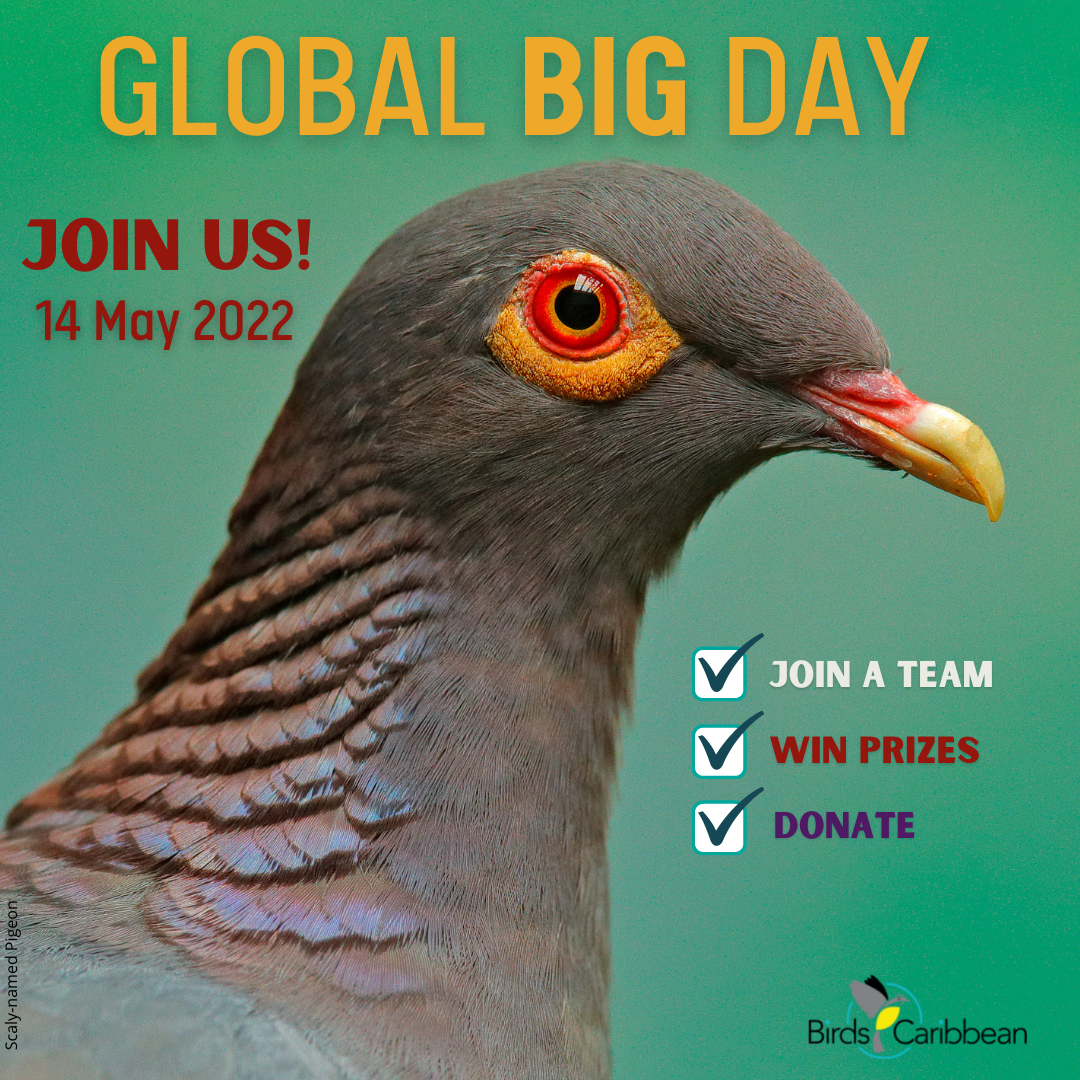
Global Big Day—the biggest birding day of the year, is just a few days away.  Again this year we are joining Birds Caribbean in its annual Global Big Day fundraiser.   This fun virtual team event pit together multi-national teams in a friendly competitive birding event in an effort to raise funds for a Caribbean Conservation, etc. This year's efforts will be geared towards raising funds to provide travel scholarships for Caribbean nationals to attend the AOS & BC Joint Conference in Puerto Rico this June. 

Last year our small team The Bajan Birders, made up of birders from Barbados and one from St. Lucia, not only had fun but also assisted in raising funds and won a few awards. 


Teammate Jerome Foster, of St. Lucia, who was only able to bird a few hours in the morning won the Life in the Wild category with “American Kestrels Mating”


and third in Best Bird Photo with an Immature Little Blue Heron.


Yours truly was awarded the Best Shorebird with an image of a Ruddy Turnstone in breeding plumage.

In all, our 9-member Bajan Birders team saw 61 species across two countries, including 8 West Indies endemic species.


This year we want to double all of those numbers, have a greater international presence and raise funds of well over $100. 

To emphasize our goal, the team was renamed “Bajan Birders & Friends”, and invitations to join our team were extended to birders across the globe.
You can join the effort by joining our team. 
To do that:
  1. Navigate here:https://givebutter.com/BCGBD2022/bajan-birders-friends
  2. Click the “JOIN A TEAM” button below the Global Big Day graphic
  3. Once on a team, send a message to your friends, family, colleagues, and networks asking them to support your team either by joining or donating.
  4. Go birding on Sat May 14 - you can simply bird in your backyard or visit as many sites as you wish during the day. 
  5. Enter your sightings into eBird or ebird Caribbean (if you are birding in the Caribbean). 
  6. Share your ebird checklist with the team's ebird account username  “BCGBDBajanBirders”.  
  7. It's that easy
If you want to donate:
  1. Navigate here:https://givebutter.com/BCGBD2022/bajan-birders-friends
  2. Click on the ‘Donate’ button. 
  3. Choose our team “Bajan Birders & Friends” from the drop-down menu
  4. Make a donation (however small, everything helps) 

Click on the ‘Donate’ button. Make a donation (however small, everything helps) to any of the teams or team members or simply donate to the entire campaign. 

  • Just follow this link  
  • Click the “JOIN A TEAM” button below the Global Big Day graphic on this page and follow the wizard.
  • On Global Big Day, May 14, share your ebird checklist with the username “BCGBDBajanBirders”.  
  • Make sure to also upload your media - images and audio files.

Come bird with us, donate and have lots of fun. Stay safe and enjoy your birding.

Wednesday, 20 April 2022

Mark Your Calendars and Join Us for Global Big Day on May 14!


It’s that time of year again! We’ll be hosting our annual celebration of Global Big Day—the biggest birding day of the year—on Saturday, May 14, 2022. This time, we are raising funds for travel scholarships to help Caribbean students and wildlife professionals attend the AOS-BC Conference in Puerto Rico this June*. 

We are bringing back our popular teams competition from 2021, and celebrating together the energy, excitement, and camaraderie that’s associated with Global Big Day.

Last year was a resounding success, with people from 192 countries reporting 7,234 species in a single day—the biggest Global Big Day turnout ever! For BirdsCaribbean, our numbers were also impressive—15 teams with members from 36 countries reported a total of 1,348 species and raised over $20,000, and we had so much fun doing this. Let’s make this year even better! Continue reading >>>


BirdsCaribbean is a vibrant international network of members and partners committed to conserving Caribbean birds and their habitats in the insular Caribbean (including Bermuda, the Bahamas and all islands within the Caribbean basin).