Wednesday, 5 February 2020

Birders visit on Celebrity Reflection

John Webster (L) with his group
On Tuesday over 25 birders arrived on board the ship Celebrity Reflection, to see the Birds of Barbados. While Barbados is not known as one of the "Birdiest" islands in the Caribbean, it does have a reputation for attracting birds uncommon to this part of the world. They saw old-world birds like Glossy Ibis, Grey Heron, and Little Egret, also island specialties such as our endemic Barbados Bullfinch, Grassland Yellowfinch, and Black-bellied Whistling Duck, and not to forget the Caribbean endemics such as Caribbean Martin, Caribbean Elaenia and the two hummers - Green-throated Carib and Antillean Crested Hummingbird. The participants also got to see our beautiful island, as they moved around between birding locations, touching all 11 parishes.  At the end of the day over 45 species were tallied among the two groups  

Birds seen on the day:

  1. Black-bellied Whistling-Duck (Dendrocygna autumnalis) +200
  2. Blue-winged Teal (Spatula discors)
  3. Pied-billed Grebe (Podilymbus podiceps)
  4. Rock Pigeon (Feral Pigeon) (Columba livia (Feral Pigeon))
  5. Scaly-naped Pigeon (Patagioenas squamosa)
  6. Eurasian Collared-Dove (Streptopelia decaocto)
  7. Common Ground Dove (Columbina passerina)
  8. Zenaida Dove (Zenaida aurita)
  9. Eared Dove (Zenaida auriculata)
  10. Green-throated Carib (Eulampis holosericeus)
  11. Antillean Crested Hummingbird (Orthorhyncus cristatus)
  12. Sora (Porzana carolina)
  13. Common Gallinule (Gallinula galeata)
  14. American Coot (White-shielded) (Fulica americana (White & Red shielded))
  15. Black-bellied Plover (Pluvialis squatarola)
  16. American Golden-Plover (Pluvialis dominica)
  17. Ruddy Turnstone (Arenaria interpres)
  18. Stilt Sandpiper (Calidris himantopus)
  19. Sanderling (Calidris alba)
  20. Least Sandpiper (Calidris minutilla)
  21. Semipalmated Sandpiper (Calidris pusilla)
  22. Wilson's Snipe (Gallinago delicata)
  23. Spotted Sandpiper (Actitis macularius)
  24. Solitary Sandpiper (Tringa solitaria)
  25. Greater Yellowlegs (Tringa melanoleuca)
  26. Lesser Yellowlegs (Tringa flavipes)
  27. Royal Tern (Thalasseus maximus)
  28. Magnificent Frigatebird (Fregata magnificens)
  29. Brown Booby (Sula leucogaster)
  30. Gray Heron (Ardea cinerea)
  31. Great Egret (Ardea alba)
  32. Little Egret (Egretta garzetta)
  33. Snowy Egret (Egretta thula)
  34. Cattle Egret (Bubulcus ibis)
  35. Green Heron (Butorides virescens)
  36. Peregrine Falcon (Falco peregrinus)
  37. Rose-ringed Parakeet (Psittacula krameri)
  38. Caribbean Elaenia (Elaenia martinica)
  39. Gray Kingbird (Tyrannus dominicensis)
  40. Caribbean Martin (Progne dominicensis)
  41. Shiny Cowbird (Molothrus bonariensis)
  42. Carib Grackle (Quiscalus lugubris)
  43. Yellow Warbler (Golden) (Setophaga petechia [petechia Group])
  44. Bananaquit (Coereba flaveola)
  45. Barbados Bullfinch (Loxigilla barbadensis)
  46. Black-faced Grassquit (Melanospiza bicolor)

Sunday, 2 February 2020

Rare Birds Update: End of January

At the end of January, Barbados had recorded 72 species of birds for the year.  Thank in part to the birding of one man, a long stay visitor who recorded 71 species for the month of January, surpassing the 66 I recorded last year.   Many of the rarities are proving to be long stay ones, but we also saw a few new ones in January. 

Continuing Birds:

  • Glossy Ibis (Plegadis falcinellus)
  • American Coot (White & Red Shielded) (Fulica Americana)
  • Grey Heron (Ardea cinerea)
  • Ruff (Calidris pugnax)


New Birds

St. Philip

Pacific Golden-Plover (FP)
Pacific Golden-Plover (Pluvialis fulva): This would be the third straight year for this Eurasian species on our shores. Could this be the same bird?
Red-billed Tropicbird (FP)
Red-billed Tropicbird (Phaethon aethereus) – These pelagic birds are returning from sea to nest in crevices along the sea cliff in St. Philip. First reported by John Webster on January 16

Christ Church

Chimney Swift (Chaetura pelagica) – A visitor who is familiar with this bird reported seeing one a the Grantley Adams International Airport.

Feel free to contact me -
100birdsbarbados@gmail.com to report any rare bird sightings, or if you need assistance identifying a bird.

Feeding Technique of Little Egret : Foot Stirring


Little Egret (Egretta garzetta)and its new world relative, Snowy Egret (Egretta thula) uses a method of foot stirring to lure prey. The above video demonstrates it.

Wednesday, 15 January 2020

American and Caribbean Coot

Yes, I am aware that since 2016, the bird that was once known as Caribbean Coot (formerly Fulica caribaea), is no more.  For scientific reasons, it has been merged into one species, called American Coot. To separate them we referred to the once Caribbean Coot as American Coot–Fulica americana (white shielded), this is because of the all-white face shield, and American Coot - Fulica americana (Red-shielded), because of the red the shows to the top of the bird's shield.  Both species are considered rare on our island, but the red shield is the rarer of the two. For most of last year Walker's Reserve, St. Andrew hosted a few of these birds but I only now noticed that the rarer “red shield” was also in the mix.  It provided for a good comparison between these not so long ago separate species of coot.
Here are the example of the two Coots:
American Coot (Red-shielded)


American Coot (white shield) formerly Caribbean Coot


Monday, 6 January 2020

Rare Birds Update: The first for 2020

At the end of the first weekend of 2020, which is really just 5 days into the new year, over 60 species has been recorded already on the island.  Thanks in part to an island wide bird count by John Webster on the 2nd, refer to as the  Christmas Bird Count in birding circles.  He tallied 45 species. Next, my effort to secure as many birds as possible, as early in the year as possible, for my 2020 Big Year challenge, resulted in me making an extra effort to get out birding.  At the 5th I had already recorded 58 species, a list of which you can see here.  We also had a few visiting birders whose observations also helped in the final tally.

A few rare birds remain with us into 2020. Here is the list parish by parish:

St. Lucy
Glossy Ibis (Plegadis falcinellus)  : This bird was with us since August 2019.
Killdeer (Charadrius vociferus): 6 birds were seen in December but have relocated to another area in the north.
Purple Gallinule (Porphyrio martinica) a juvenile was spotted for the first time late last month and was last seen on the weekend.

St. Andrew
American Coot (White Shield) (Fulica americana(caribaea)): Once known as Caribbean Coot, while rare, has nested on the island before. Even though Barbados records one or two of these birds yearly for a few months, the wetlands at Walkers Reserved has attracted a few that stayed there for most of 2019 and now into 2020.
American Coot (Red Shield) (Fulica Americana) This variation of this bird is very rare to this part of the Caribbean. Two was seen among the White shielded on 4th at Walkers
American Redstart (Setophaga ruticilla) two of these warblers were recorded at Turners Hall Woods on the 4th
Prothonotary Warbler (Protonotaria citrea) One record at Turners Hall Woods on the 4th

St. George
Grey Heron (Ardea cinerea)  This large heron was seen at one of the irrigation ponds at Redland

St. Philip
Ruff (Calidris pugnax) two bird shorebirds are still with us in 2020

Christ Church
Prothonotary Warbler (Protonotaria citrea) was seen on the last day of 2019 among the Mangroves at the Graeme Hall Swamp. Efforts to relocate it thus far was unsuccessful.


St. Michael
Laughing Gull (Leucophaeus atricilla) - at Pile Bay, rare for this time of year.

Feel free to contact me - 100birdsbarbados@gmail.com to report any rare bird sightings, or if you need assistance identifying a bird.


Sunday, 24 November 2019

Birders Out In Full Force (November 23)


The local birders were out in full force this morning, spanning from the east to the north coast. Even though we did not visit all of the birding areas, we recorded over 40 species, including a few rare ones.


The North
My son Jason and I, visited the northern parish of St. Lucy. It was a complete contrast to the last time I visited.  Then everything was dry, now, every location  we visited had water, with some even full to the brink.  This was because of the downpour of rain we had during the last week. Many shorebirds were around, with us recording over 10 species including a <>rare Killdeer (Charadrius vociferus).  The ducks are still arriving and we counted 31 Blue-winged Teals (Spatula discors) at one location.  As the water settles and Dragonflies, fish, and tadpoles begin to strive in them, I am sure the number of birds will increase.


The East


John Webster, Ed Massiah, Jason and I all visited eastern parishes. John spent most of his time at Greenland collecting images - stills, and motion on a rare male Northern Pintail (Anas acuta) at that pond.  He also drew our attention to a duck he saw there that was much like a female Blue-winged Teal but had a very light-colored belly/underbody when compared to the Blue-winged Teal. It was also somewhat smaller. 


Ed went to the eastern parish of St. Philip to see a pair of Ruffs,  first seen by John two days ago. Sadly he did not see them but saw over 40 Black-bellied Plovers and over 50 Semipalmated Sandpiper and a semirare Western Sandpiper.


Jason and I added another an eastern rarity to the list and a lifer for him. We saw a juvenile Purple Gallinule at Redlands Irrigation Pond in the parish of St John.


A good morning of birding was had by all. Below are the birds we saw.

  1. Blue-winged Teal - Spatula discors
  2. Northern Pintail Anas acuta
  3. Scaly-naped Pigeon - Patagioenas squamosa
  4. Eurasian Collared-Dove - Streptopelia decaocto
  5. Common Ground Dove - Columbina passerina
  6. Zenaida Dove - Zenaida aurita
  7. Common Gallinule - Gallinula galeata
  8. Green-throated Carib - Eulampis holosericeus
  9. Antillean Crested Hummingbird - Orthorhyncus cristatus
  10. Purple Gallinule - Porphyrio martinica
  11. Black-bellied Plover - Pluvialis squatarola
  12. Semipalmated Plover - Charadrius semipalmatus
  13. Killdeer - Charadrius vociferus
  14. Stilt Sandpiper - Calidris himantopus
  15. Ruddy Turnstone - Arenaria interpres
  16. Least Sandpiper - Calidris minutilla
  17. White-rumped Sandpiper - Calidris fuscicollis
  18. Semipalmated Sandpiper - Calidris pusilla
  19. Western Sandpiper - Calidris mauri
  20. Short-billed Dowitcher - Limnodromus griseus
  21. Wilson's Snipe - Gallinago delicata
  22. Spotted Sandpiper Actitis macularius
  23. Solitary Sandpiper - Tringa solitaria
  24. Greater Yellowlegs - Tringa melanoleuca
  25. Lesser Yellowlegs - Tringa flavipes
  26. Magnificent Frigatebird - Fregata magnificens
  27. Great Egret - Ardea alba
  28. Snowy Egret Egretta thula
  29. Green Heron - Butorides virescens
  30. Black-crowned Night-Heron - Nycticorax nycticorax
  31. Belted Kingfisher - Megaceryle alcyon
  32. Caribbean Elaenia - Elaenia martinica
  33. Gray Kingbird - Tyrannus dominicensis
  34. Black-whiskered Vireo - Vireo altiloquus
  35. Shiny Cowbird - Molothrus bonariensis
  36. Carib Grackle - Quiscalus lugubris
  37. Yellow Warbler - Setophaga petechia
  38. Barn Swallow - Hirundo rustica
  39. Grassland Yellow-Finch - Sicalis luteola
  40. Bananaquit - Coereba flaveola
  41. Barbados Bullfinch - Loxigilla barbadensis
  42. Black-faced Grassquit - Melanospiza bicolor


Monday, 28 October 2019

Rare Birds Update: October


October is always a hive of activity for local birders as we all head north to the parish of St. Lucy in search of migratory birds.  One must-see on most of our list is a small bird, a champion of migration, the Blackpoll Warbler (Setophaga striata)*.  This small bird makes a 12,400 miles (20,000 km) roundtrip each year, some crossing the entire North American continent before making a nonstop trans-ocean flight for up to four days to South America.  Other than the Blackpolls, we saw some other rare birds for the island.

Mega-Rare
  • Ed Massiah reported a Wilson's Plover (Charadrius wilsonia) at Chancery Lane, Christ Church on the 5th.  He also noted that one of the Whimbrels there was a European subspecies.

Black-headed Gull 
  • A Black-headed Gull (Chroicocephalus ridibundus) was seen perching on the roof of a fishing boat moored at Pile Bay, St. Michael.
  • On Wednesday afternoon of the 23rd, while out in the field with the University of the West Indies, Bio-diversity study students, we observed a Common Nighthawk (Chordeiles minor ), which flew directly over our heads. 

White-winged Tern
  • A White-winged Tern (Chlidonias leucopterus) was seen from the 10th to 12th in St. Lucy.  This may have been the same bird that was seen in St. Philip during September.
  • A pair of Northern Shoveler (Spatula clypeata), the shovel billed duck, was seen in St. Lucy on 

Rare

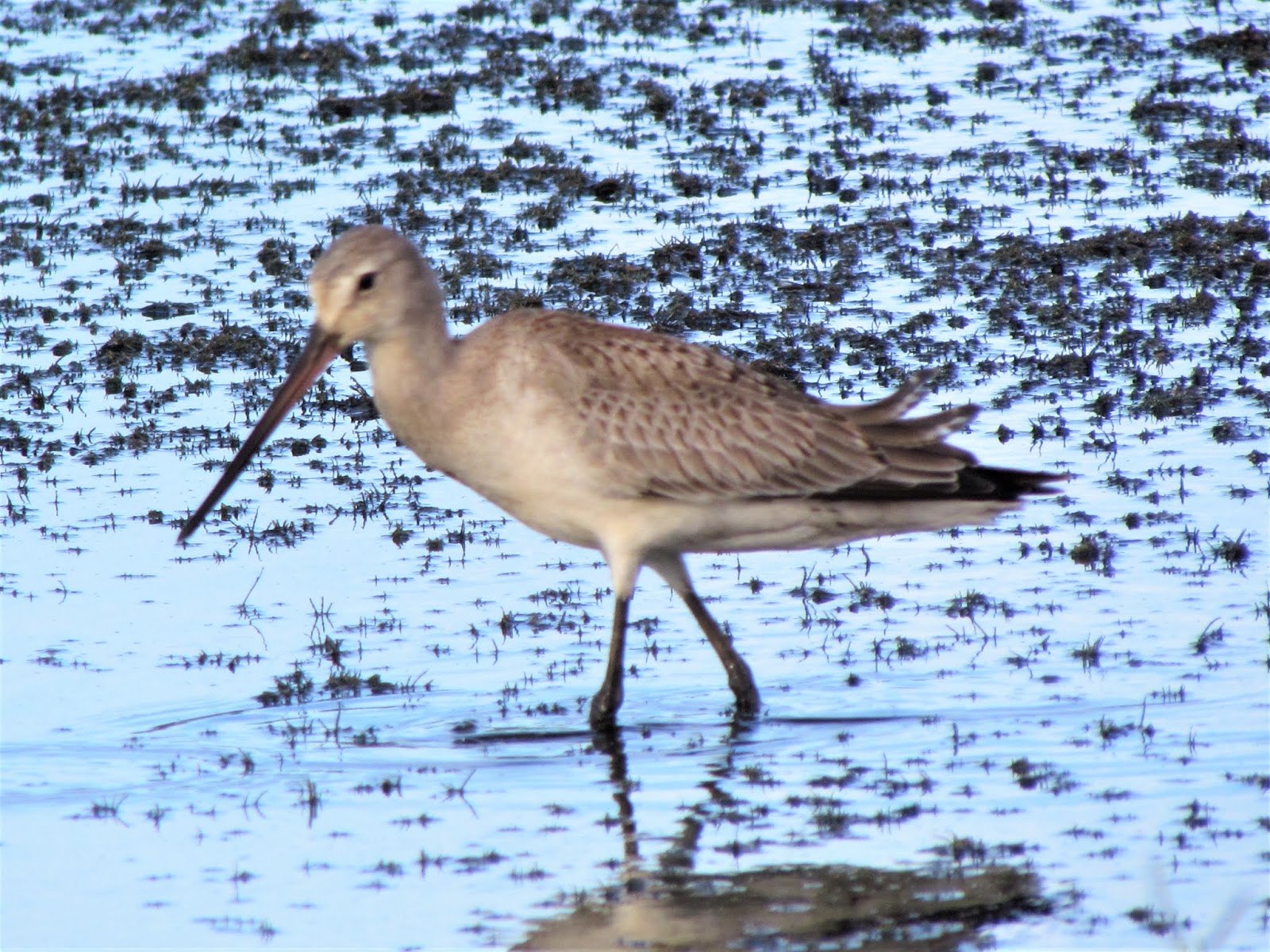
Hudsonian Godwit
  • Three Hudsonian Godwits (Limosa haemastica) sightings were reported in October.  The first two on the 3rd at Chancery Lane and the 18th in St. Philip, were seen by John Webster and I saw the third on the 23rd in St. Lucy.

  • A Juvenile Purple Gallinule (Porphyrio martinica) was discovered at Greenland, St. Andrew by John Webster on the 20th

  • Bobolinks
  • Bobolinks (Dolichonyx oryzivorus) in St. Lucy on 19th 

Continuing Rares 
Grey Heron
  • Grey Herons (Ardea cinereal) were seen in St. Lucy, St. Andrew, St. Thomas and St. Philip. This may have just been two birds moving around;  
  • Glossy Ibis (Plegadis falcinellus) in St. Lucy first seen in August; 
  • American (Caribbean) Coots
  • American (Caribbean) Coots (Fulica americana) has grown to 5 in total at Walkers Reserve, St. Andrew. 
  • A Brown Pelican (Pelecanus occidentalis)  continues on the south coast. It was photographed by my niece at Carlisle's Bay.

v
Blackpoll Warbler

Notable Mentions: The Blackpoll Warbler (Setophaga striata) migration is in full effect and a few birds were seen in the latter half of October; Yellow-billed Cuckoos (Coccyzus americanus) were seen in St. Lucy, St. Andrew and St. John during the month.  The Pied-billed Grebes(Podilymbus podiceps) at Walkers are continuing to grow in numbers – a visit to the reserve on the 26th  tallied 10 birds, mostly adults.  It was good to see the return of this bird to St. Andrew.


As we move into November, rarity month, stay tuned to this blog for the most up to date local birding sightings.


        *About Blackpoll migration and here